BYO Shape Pipeline
For: anyone bringing their own Xano instance to this pipeline, and anyone who intends to run the permissions boundary on Kubernetes and the model on Google AI rather than on the defaults.
The promise this document has to keep: every dependency named below is self-serve. No enterprise agreement, no named account team, no seat you have to negotiate for. Where a component could be bought, the open path is stated beside it. If you hit a paywall following these instructions, that is a bug in the instructions.
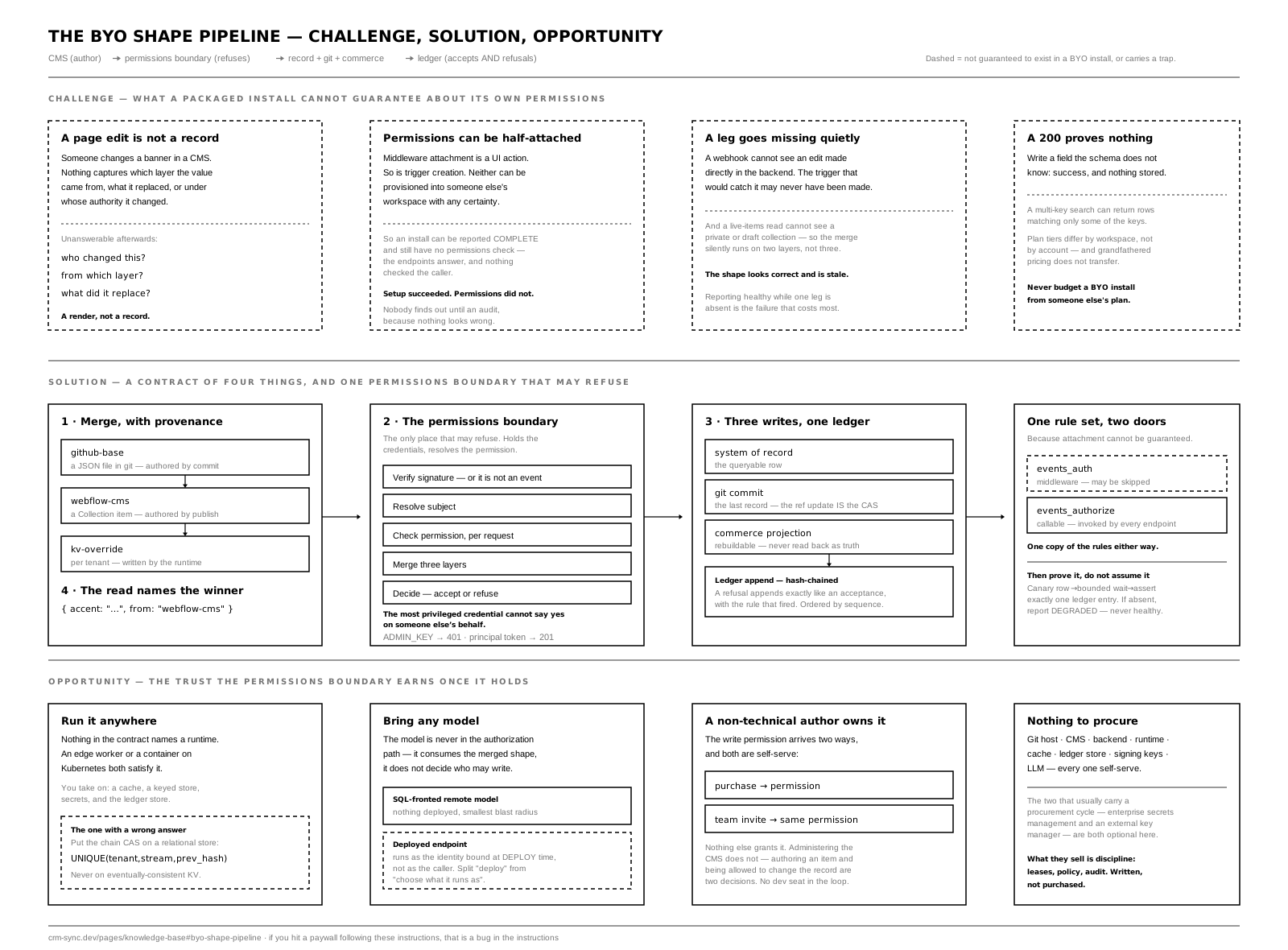
The whole pipeline on one page. Dashed borders mark everything a packaged install cannot guarantee, or that carries a trap — read those first.
What a shape is, and why the contract is small
A shape is a data model that a design surface authors and a runtime renders. Not a page edit — a record with fields, provenance, and a version. Designers and developers exchange shapes; the edge merges every change, checks permissions, and ledgers it.
The whole contract is four things. Implement these and you are on the pipeline, whatever else you swap:
- A merge order, deterministic, with per-field provenance.
- A permission that must hold before a write, resolved per subject at request time.
- A ledger append on every accepted change, hash-chained.
- A read endpoint that returns the merged shape and which layer won each field.
Everything else — the runtime, the model, the CMS, the store — is substitutable. That is the point of writing the contract down rather than shipping a connector.
The merge order
Three layers, lowest to highest precedence:
| Layer | Provenance tag | Home | Who authors it |
|---|---|---|---|
| Base | github-base | A JSON file in a git repo | Developers, by commit |
| CMS | webflow-cms | A Collection item, slug matching the shape | A non-technical author, by publish |
| Override | kv-override | Per-tenant key-value | The runtime, per store |
A field present in a higher layer wins. A field absent falls through. The response must name the winning layer per field — a merged shape that cannot say where a value came from is a render, not a record, and you have lost the only property worth having.
Reference implementation: base at shape-promo.json in this repo, CMS layer resolved by Collection slug shapes, override at a tenant-scoped KV key. Collection id is cached for an hour and can be pinned to skip discovery. Reads carry a 60-second edge micro-cache so the CMS API is never hammered.
One thing to decide before you build
The reference reads the CMS live items endpoint — published items only. If your authors work in a private or draft collection, that layer will be invisible and you will debug a merge that silently has two layers instead of three. Either have authors publish, or read the drafts endpoint and accept that unpublished work goes live at merge time. Pick deliberately; both are defensible, and the failure mode of picking by accident is a shape that looks correct and is stale.
The write path
Two legs. Build the first; the second is what makes it survive contact with a real tenant.
Leg 1 — the primary path, through the permissions boundary
CMS publish
  → webhook (HMAC-verified)
  → permissions boundary: resolve subject, check permission, merge, decide
  → write: system of record + git commit + commerce projection
  → ledger append (hash-chained)
The permissions boundary is the only place that may refuse. It holds the credentials, it resolves the permission, and it records both outcomes. A refusal appends to the ledger exactly like an acceptance — a rejection that leaves no trace is indistinguishable from a bug, and the first question anyone asks after an incident is what you refused and when.
Verify the webhook signature before anything else. An unverified event is not a lower-confidence event; it is not an event. If your CMS emits any webhook variant it does not sign, that variant is an unauthenticated write path into your record — allow-list it to the topics that genuinely cannot be signed, or reject it.
Leg 2 — the catch-up path, a Xano Database Trigger
The webhook cannot see an edit made directly in the backend. A Database Trigger on the shapes table can, and it is the right primitive for it — not middleware, which wraps an endpoint, and not a Realtime trigger, which fires on channel activity.
Use it as a reconciler, not as the primary path:
- It runs on insert and update, and re-emits the change into the same merge and ledger.
- It must be idempotent. The same row arriving twice must produce one ledger entry, not two.
- It must not be the only way a change reaches the record, because you cannot guarantee it exists.
That last point is the whole BYO problem, and it deserves its own section.
BYO Xano: the permissions check must exist twice
Middleware attachment is a UI action. So is trigger creation. Neither can be reliably provisioned into someone else's workspace, which means a packaged install can be complete and still have the permissions check half-attached, or absent.
The pattern that survives this is already in the reference implementation, and its own description says why it exists:
The gate as a callable. Same rules as the middleware, reachable by an endpoint directly — so a packaged install is secure even when the UI-only middleware attachment is skipped or half-done. Returns the resolved tenant and scopes; throws on any failure. One copy of the rules either way.
So: write the authorization rules once, expose them twice — as a pre-middleware for the normal path, and as a callable function that every endpoint invokes directly. The endpoint does not assume the middleware ran. If both are present the rules execute once and agree, because there is only one copy of them.
Verify, do not assume
Provisioning a trigger is a setup step. Proving it fires is a different thing, and only the second one is worth anything. Ship a probe:
- Write a canary row to the shapes table through the backend directly, bypassing the webhook.
- Wait a bounded interval.
- Assert the ledger contains exactly one entry for that canary.
- If not, the tenant's install is degraded, not broken — say so plainly on their status surface, and keep the primary path running.
A pipeline that reports healthy while one leg is silently absent is the failure that costs the most, because nothing looks wrong until an audit asks.
Backend traps that will bite you
- Silent field drops. Writing a field the schema does not know returns success and stores nothing. Read back what you wrote, or assert the response shape — do not trust a 200.
- Multi-key search ignoring a filter. A search with several keys can return rows that match only some of them. Validate the rows you got, do not assume the query constrained them.
- Plan tier, and whose plan. Trigger availability and execution limits vary by tier. Check the tier of the instance the pipeline will run on during onboarding, not when a trigger silently fails to fire. Two traps here: a workspace can sit on a different tier from the account that owns it, so read the label on the workspace rather than the invoice; and grandfathered pricing does not transfer. If whoever wrote your runbook holds an early fixed-fee plan, the person following it today is quoting current rates, possibly usage-based. Never budget a BYO install from someone else's plan.
Entitlement: how the write permission is granted
Writes require one permission. It arrives by exactly two routes, and both are self-serve:
| Route | Mechanism |
|---|---|
| Purchase | A matching purchase grants the permission to the buying subject. |
| Invitation | A team invite carrying the shape role tag grants the same permission. |
Nothing else grants it. In particular, being an administrator of the CMS does not — authoring a Collection item and being permitted to change the record are separate decisions, and collapsing them hands the record to whoever holds a design seat.
Grant the write permission and nothing adjacent. A shape author needs to write shapes; they do not need theme control, release promotion, or evidence export. If your role model cannot express that distinction, the role model is the thing to fix — not the permission.
Check the permission at the point of action, not at the door. A session that was entitled when it started may not be entitled now. Resolve per request, per subject.
The N+1 lag: when a permission change takes effect
A permission change has two moments, not one, and a BYO implementer has to know which of them their code is reading.
- Effective state — the latest event in the current session. Changes the instant the subject acts. This is what a permission check at the point of action must read.
- Projected state — the per-subject projection that downstream consumers read: audience builders, weighting, exports. It is honoured from the next session (N+1), not this one.
So a subject who revokes in session N sees effective: revoked sitting next to projected: granted for the remainder of that session. That is a design decision, not a lag you failed to close, and it exists for a reason worth stating: the projection is what a whole audience or export is built from, and recomputing it mid-session would make one session internally inconsistent — half its rows built under the old state, half under the new.
What must never lag. The permission check on a new action reads effective state. If a subject revokes and then an agent attempts a write, that write is refused immediately — it does not get one more session of grace. Two reads, two sources, deliberately:
| Question | Reads | Timing |
|---|---|---|
| May this action proceed? | Effective state | Immediate |
| May this subject be in tomorrow's audience? | Projected state | From N+1 |
Stated as prose, because the two rows above are the whole rule and a table is easy to skim past: the question "may this action proceed?" reads effective state and is answered immediately, while the question "may this subject be in tomorrow's audience?" reads projected state and is answered from the next session — the N+1 lag. An agent attempting a write one second after a revoke is refused on the spot. The same subject stays in an audience already being built, and drops out of the next one.
The N+1 lag therefore applies to derived consumers only: audience builds, weighting, exports, anything that reads the projection. It never applies to a permission check on a new action. If you remember one sentence from this section, that is the one — a revoke is immediate for doing, and next-session for being counted.
And the enforcement is deletion, not filtering. When the projection flips to revoked, any derived weight for that subject is destroyed, not down-ranked — the identity-map row goes, and the cached score goes with it. A revoked subject does not become a low-scoring subject; they stop having a score at all. This is the gate-versus-weight rule made operational: a permission removes the row, a weight orders the rows that survived.
Reconcile in both directions. A drift pass should count subjects who are targetable but not consented and subjects who are consented but not targetable. Most estates check only the first. The second one — someone permitted you and is unreachable — is the failure nobody looks for, and it is the one that quietly costs revenue rather than compliance.
Say the N+1 lag out loud before a reviewer finds it. It looks like a bug in a screenshot and it is not one. Undocumented, it is the single most expensive thing on this page to explain under audit conditions; documented, it takes one sentence.
Two git paths, two jobs — and why that is the non-blocking order
Sooner or later you will want to publish more than the shape back to git: categories, tags, product JSON. There is a trap in the obvious way to do it, and a way round the trap that requires deciding nothing.
The trap. The merge order puts github-base at the bottom — it is the layer the CMS overrides. If the CMS now also writes to git, the same value exists at two precedence levels. That is stable while the CMS item exists, because the CMS layer still wins. It breaks on delete: removing a field in the CMS will not revert to nothing, it will fall back to the last value the CMS itself pushed. The author deletes something and it stays, wearing a different provenance tag. Nothing errors.
The way round. Give git two paths with two jobs, and never let one become the other:
| Path | Job | Read by the merge? | Precedence |
|---|---|---|---|
shape-<name>.json | Base layer — the default a CMS item overrides | Yes | Lowest |
destinations/… | Record — append-only log of what was published | No | None; it is not a layer |
Categories, tags and product JSON go to the second path as records: append-only, sequence-stamped, written by the pipeline and read by nothing in the merge path.
Three things follow, and each one is a decision you no longer have to make:
- No precedence loop, because no new value is ever read as a layer.
- Delete becomes representable. A deletion appends a delete record at sequence N. There is no fallback to reason about, because nothing falls back.
- No embedding decision. Records do not touch a vector index, so any question about how overrides overwrite drafts in a search index is deferred, not blocked.
Stamp the records now, even though nothing reads them
Every record carries as_of_seq, the source layer, and the actor — from the first write, while it is still write-only. If you later decide these should be merge layers, the provenance is already present and it is a reader change. Without it, the same decision is a migration over history you cannot reconstruct.
The ordering principle is worth stating on its own: write-only first, read-later. Adding a reader to an existing record is cheap and reversible. Removing a layer that other things already merge from is neither — you cannot un-publish a default that has been quietly winning for months, because you no longer know which of the values downstream came from it.
Swapping the runtime: Kubernetes
Nothing in the contract requires a specific runtime. The permissions boundary is a request handler that can resolve a subject, check a permission, merge three layers, write, and append to a ledger. A container on Kubernetes does that as well as an edge worker.
What you take on when you move it:
| Concern | Edge default | On Kubernetes |
|---|---|---|
| Micro-cache | Edge cache, built in | Your own cache; add one, or the CMS API takes every read |
| Per-tenant KV | Key-value binding | Any keyed store — Redis, a table, a ConfigMap for static tenants |
| Ledger | Chained rows with a unique-index compare-and-swap | Any store that gives you a CAS on the chain tip — see below |
| Secrets | Runtime secret binding | Kubernetes Secrets, or a cloud KMS; do not bake them into images |
| Signature verification | Standard crypto | Same; no platform dependency |
The ledger is the one that has a wrong answer. The chain needs a compare-and-swap on the tip so two concurrent writers cannot both commit against the same predecessor. A unique constraint on (tenant, stream, previous_hash) gives you exactly that in any relational store: the loser takes a constraint violation, re-reads the tip and retries. Do not implement this on an eventually-consistent key-value store — a read after a write can return the old tip, both writers chain from the same point, and the verifier then reports the whole chain as broken. A concurrent write becomes indistinguishable from tampering, which destroys the evidence in both directions at once.
Order by sequence, never by timestamp. Timestamps from a distributed runtime are not monotonic and are not a total order.
Swapping the model: Google AI and other LLM services
The pipeline does not care which model you call, because the model is never in the authorization path. Ranking, enrichment and generation consume the merged shape; they do not decide whether a write is permitted. Keep it that way.
Two integration shapes, both self-serve:
- SQL-fronted. Declare a remote model in your warehouse and call it from a query. Nothing is deployed, there is no serving endpoint, and no service account is bound to inference. The simplest thing that works, and the one with the smallest blast radius.
- A deployed endpoint. More capable, and it introduces the permission problem worth knowing about before you meet it: an endpoint executes as the identity bound to it at deploy time, not as the caller. A caller holding only "invoke" reaches every data source that deploy-time identity can read. Give each endpoint its own minimal service identity, and make sure nobody holds both "deploy a model" and "choose what it runs as" — that pair is the real privilege boundary, and it is usually assigned by two different people months apart.
If you encrypt training data or model artifacts with your own key, a cloud key service is self-serve and priced per key and per operation. External key managers exist and are enterprise-sold; you do not need one to hold your own key.
The no-blocker inventory
Every dependency, and how you get it:
| Dependency | Self-serve? | Open alternative |
|---|---|---|
| Git host | Yes, free tier | Any git remote; the contract needs a repo, not a vendor |
| CMS for the authoring layer | Yes | Any CMS with an items API and webhooks; the layer is a JSON merge |
| Backend / system of record | Yes | Any backend with triggers and a function stack |
| Edge or container runtime | Yes | Any HTTP runtime |
| Key-value / cache | Yes | Redis, or a table |
| Ledger store | Yes | Any relational store with a unique index |
| Signing keys | Yes | Generate locally; publish the public half as a JWKS |
| Cloud key service (optional) | Yes, per-key pricing | Self-hosted transit signing, at the cost of running it |
| LLM | Yes, pay-per-token | Any provider, or a local model |
| Secrets management | Yes | Runtime secret bindings or Kubernetes Secrets |
Nothing in that table requires a procurement cycle. The two components that usually carry one — enterprise secrets management and an external key manager — are both marked optional, with the open path beside them, because the discipline they sell is written rather than purchased: leases instead of long-lived strings, policy instead of key possession, audit as a first-class output.
What to check before you call it done
- A merged read names the winning layer for every field.
- A write without the permission is refused, and the refusal is in the ledger with the rule that fired.
- The webhook signature is verified, and every unsigned variant is either allow-listed by topic or rejected.
- The canary probe proves the catch-up trigger fires, and a degraded install says so.
- Two concurrent writes to the same chain tip produce one commit and one retry — not two commits, and not a forked chain.
- Replay is by sequence, never by timestamp.
- Anything written back to git is either a base layer the merge reads, or an append-only record it does not — never both for the same field.
- The N+1 lag is documented where a reviewer will read it, and the permission check on a new action reads effective state — not the projection.
- No model sits in the authorization path.
- Every credential the pipeline uses is held by the component that can refuse a request, and by no other.
The last one is the summary of all the others. A pipeline is trustworthy exactly to the degree that the thing holding the credentials is also the thing that can say no.