From product.csv to Consented Conversions
For: teams whose catalog still reaches Google and Amazon as an exported spreadsheet. Premise: the spreadsheet isn't wrong, it's late. Everything below replaces the lateness, not the catalog. Companions: The Trust Framework for why a record matters; AI Trust Framework Requirements for the REST layer; Global compliance harness checklist for the wider release gate. Download: CONSENTED-DATA-LAYER-TEST-HARNESS.md, the eighteen-test harness · diagrams as image or PDF (challenge, solution, benefit) and image or PDF (before and after).
The gap, in one sentence
A product.csv export describes the catalog as it was when someone ran the export. Google and Amazon now ask about each event as it happens, and they drop the events that can't show consent.
A nightly file can't say what a shopper agreed to at 14:32, because at 14:32 the file didn't exist.
What changed in the last year
| Date | Platform | Change | What it does to a CSV data layer |
|---|---|---|---|
| 2026-08-18 | Content API for Shopping sunset; HTTP 410 errors from Sept 1, full shutdown early 2027 | Programmatic feeds must move to the Merchant API | |
| 2026-06-30 | Amazon | Consent signal required on the Ad Tag, Conversions API and Events API for UK and EEA traffic; some sources add Switzerland | Conversions with no signal aren't used |
| 2026-06-15 | ad_storage alone gates conversions and remarketing (reported, not yet confirmed by Google) | No fallback when consent is missing | |
| 2026-04-14 | Product data spec update: video_link, handling cutoff, minimum order value; 500×500 image minimum from 2027-01-31 | New columns a static export doesn't carry | |
| 2025-07-31 | Amazon | XML and flat-file listings feeds retired | Listings must go out as JSON_LISTINGS_FEED |
None of these is a ban on spreadsheets. Each one moves a decision from the file to the moment of the event.
Challenge, solution, benefit
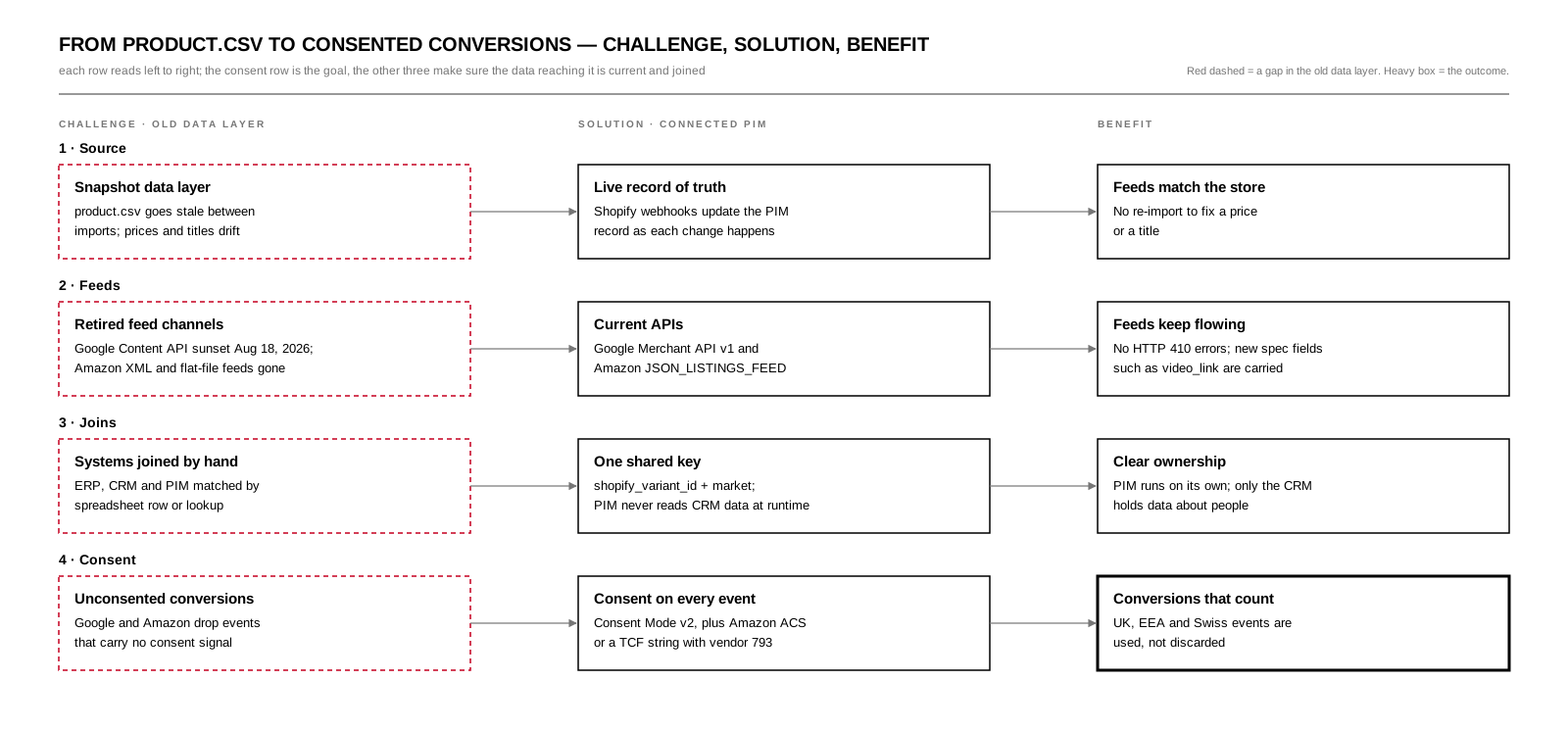
Open the SVG full size (1600 × 744) · Download the image · Download the PDF.
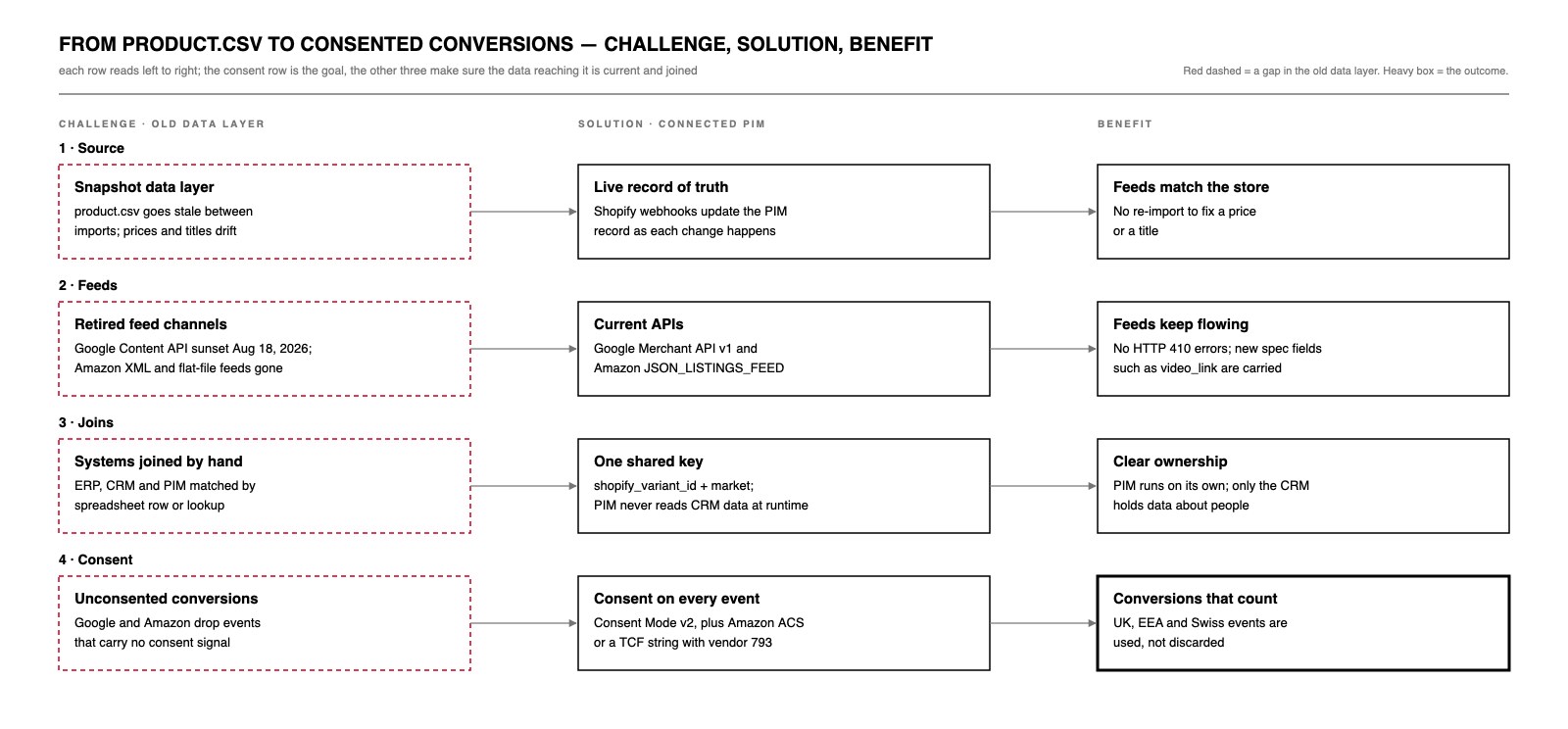
Read each row left to right. The consent row is the goal. The other three make sure the data that reaches it is current, joined by key and owned by one system.
- Source. The export is replaced by webhooks. A price changed in Shopify reaches the PIM when it changes, not at the next import.
- Feeds. The retired channels are replaced by the APIs that replaced them. Nothing about the catalog changes; only the door it leaves through.
- Joins. Rows matched by position are replaced by one key,
shopify_variant_id + market. ERP cost and stock arrive keyed by SKU and variant. - Consent. The consent state travels with the event instead of being assumed. An event without it is not sent.
Before and after
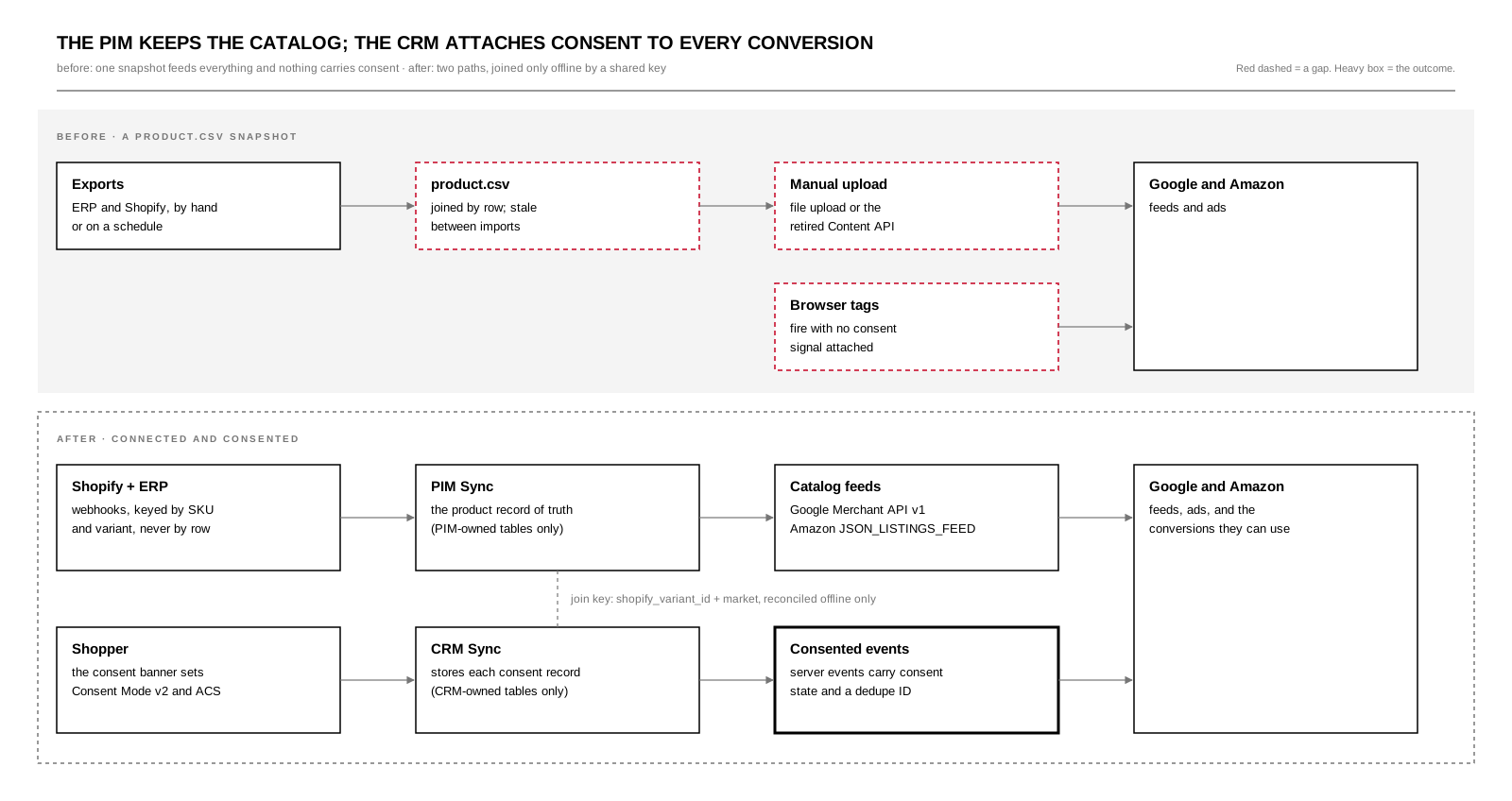
Open the SVG full size (1600 × 848) · Download the image · Download the PDF.
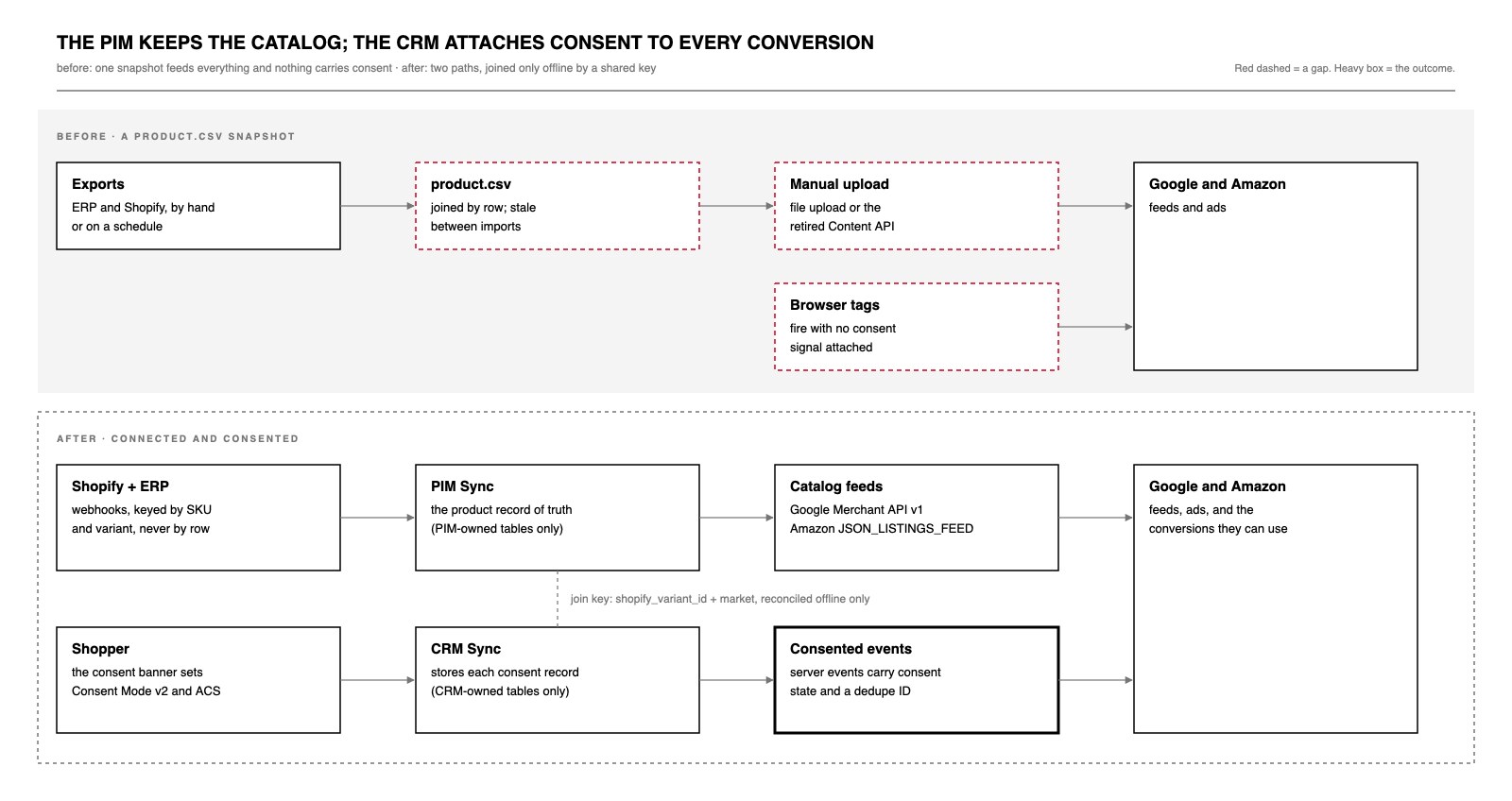
The catalog and consent take separate paths, and that separation is the design, not a gap.
- The PIM owns the product record. It writes only its own tables and never reads CRM data at runtime. It runs on its own if the CRM is absent.
- The CRM owns the person. Consent, identity and conversions live there, and only there.
- They meet offline, by key.
shopify_variant_id + marketreconciles a conversion to the product it was for, without either system reading the other's tables.
A PIM that never holds personal data can't leak it, and it doesn't have to be in scope for every privacy request.
Readiness checklist
Each item has a test with the same ID in the harness below.
Feeds
- FD-01 No Content API calls anywhere in the codebase
- FD-02 Any Google feed push uses Merchant API v1, not an alpha or beta version
- FD-03 Amazon listings go out only as
JSON_LISTINGS_FEEDor through the Listings Items API - FD-04 Every product image is at least 500×500 before 2027-01-31
- FD-05
video_link, handling cutoff and minimum order value are mapped, or left out on purpose - FD-06
native_commerceandmerchant_item_idsit in a supplemental source, if checkout inside Google AI Mode is wanted
Identifiers and joins
- ID-01 Every product has a GTIN, or a brand plus MPN
- ID-02 Every catalog row carries
shopify_variant_id + market - ID-03 ERP fields arrive keyed by SKU and variant, never by CSV row order
- ID-04
product.csvis an import or export only; the PIM is the record of truth
Consent
- CN-01 The banner sets
ad_storage,ad_user_data,ad_personalizationandanalytics_storagebefore any Google tag fires - CN-02 UK, EEA and Swiss visitors send
amzn_user_dataandamzn_ad_storage, or a TCF string with vendor 793 - CN-03 Server-side conversions carry the consent state and a dedupe ID
- CN-04 No ad cookie is set before consent
PIM and CRM boundary
- BD-01 The PIM writes only the tables its boundary contract names
- BD-02 The PIM never reads CRM tables at runtime
- BD-03 The three GDPR webhooks are handled
- BD-04 No customer personal data is stored in the PIM
The test harness
Download the consented data layer test harness (Markdown) →
Eighteen tests, one per checklist item. Seven are shell commands you can run from the repository root today. One runs in the PIM's own test page. The other ten are browser or dashboard checks with a stated pass condition.
Run it in order. The feed and boundary checks are fast and catch code problems. The consent checks need a UK or EEA exit and a clean browser, and they catch configuration problems that no code search will find.
A test that hasn't run is not a pass. The harness ends with a results log. An empty row is an open item, not a green one.
Sources
- Content API deprecation and sunset — Google
- Merchant Center product data specification update 2026 — Google
- Feeds API best practices — Amazon SP-API
- Deprecation of Feeds API support for XML and flat-file listings feeds — Amazon SP-API
- Amazon Ads consent deadline June 30 — PPC Land
- Amazon DSP EU consent policy — AppsFlyer
- Amazon Consent Signal — Usercentrics
- Google Consent Mode update June 2026 — Xictron
- UCP and Merchant Center — ChannelEngine