Render and Runtime: A Working Dictionary
For the business analyst and the designer sitting in an architecture review.
Every term below is defined by the decision it changes. A definition that does not change a decision is trivia, and trivia is why glossaries go unread.
The pivot the rest of this depends on
AI pivot, privacy. Privacy was historically a disclosure discipline: show a notice, collect a choice, honour it at render time. That model assumed the reader was a person who would see only what the page displayed.
An agent does not read a page. It reads the payload, the API, the export and the index — and then it infers, joins and acts. Two consequences reorganise the discipline:
- Withholding is no longer a rendering decision. Data that reaches the client is disclosed, whether or not it was displayed.
- A machine states an inference with the confidence of a fact. The governance failure is no longer a wrong number. It is a confident wrong number, produced at speed, from inputs that were each individually correct.
Which is why the terms below are worth precision: they mostly describe where computation happens and what crosses a boundary — and that has become a privacy question rather than a performance one.
Rendering models
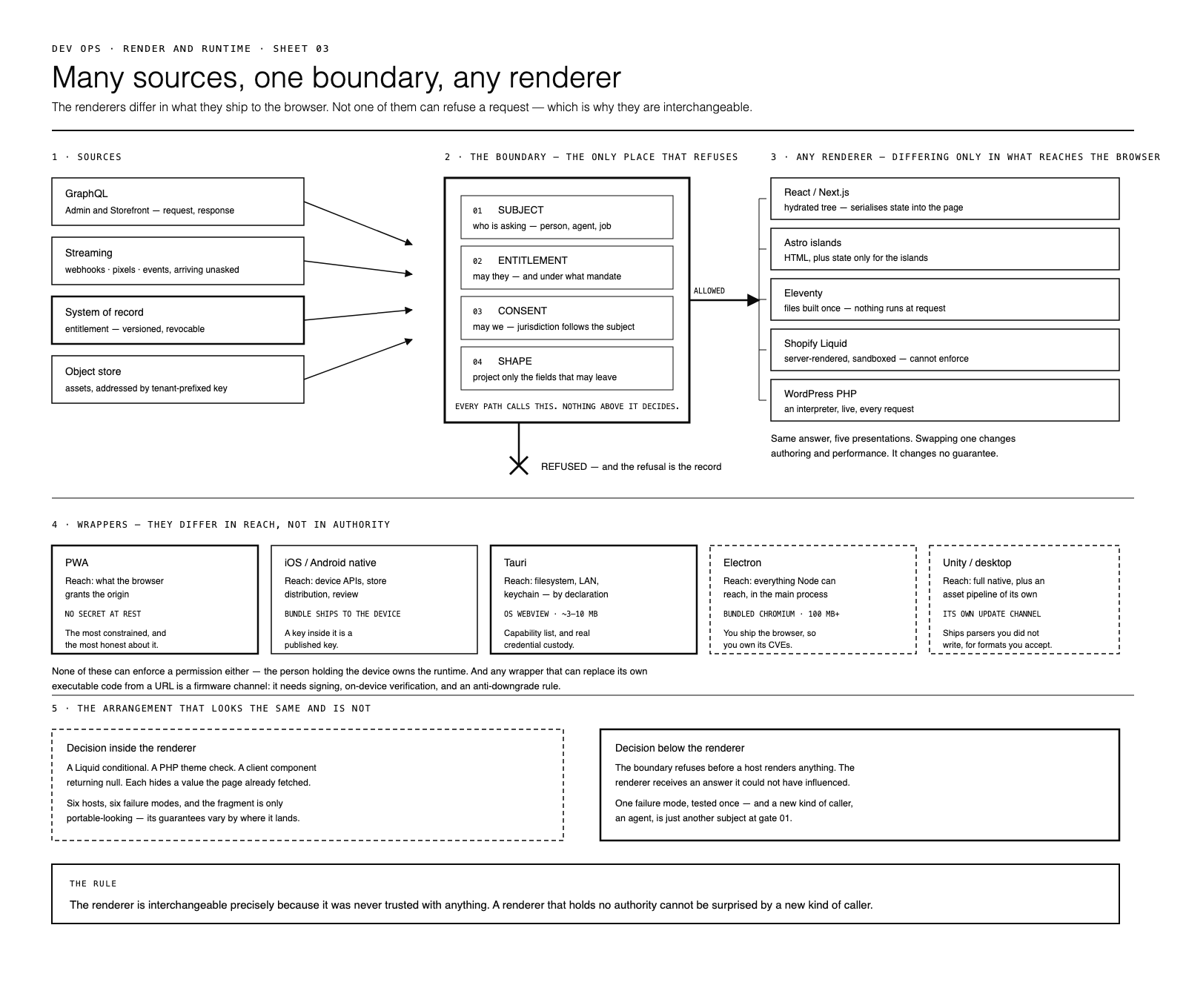
Server-side rendering (SSR). HTML is assembled on a server for each request. The client receives a document. Whatever the server included is disclosed; whatever it omitted was never sent.
Client-side rendering (CSR). The server sends a shell plus JavaScript; the browser builds the document. The data must therefore travel to the browser to be rendered there.
Hydration. A page arrives as server-rendered HTML and then JavaScript "wakes it up" — attaching handlers and reconstructing component state. The structural requirement is the important part: to rebuild the tree, the client must receive the data the server rendered from. Props crossing into a hydrated component are serialised into the page and are readable in view-source.
ISR — Incremental Static Regeneration. Pages are pre-built as static files and re-generated periodically or on demand, rather than per request. A cache with a build step.
The decision it changes: an ISR page is generated once and served to everyone until it regenerates. Anything personalised, entitlement-dependent or consent-dependent that gets baked into it is disclosed to the next visitor. ISR and per-subject content are close to incompatible, and the failure is silent.
Islands architecture. The page ships as ordinary HTML; only designated interactive components hydrate. The rest is inert markup that never becomes a component.
The decision it changes: less JavaScript, and — more importantly — less serialised state, because only islands need their data shipped. The boundary is narrower by construction rather than by discipline.
Frameworks, described by what they ship
Astro. Static-first, islands by default, ships zero JavaScript unless a component is explicitly marked interactive. Content-heavy sites end up as documents rather than applications.
Eleventy (11ty). A static site generator with no client runtime at all by default. It runs at build time, emits HTML, and is finished. Nothing of Eleventy exists at request time.
Petite Vue. A ~6 KB subset of Vue designed to add small reactive behaviours to server-rendered HTML — sprinkles on a document, not a framework that owns the page.
HTMX. The server returns HTML fragments; the client swaps them into the DOM. There is no client-side application state, therefore no serialisation of it.
Next.js. A React framework with server components, client components and a hydration model. Powerful, and it carries a client runtime that must be fed state.
HTMX against Next.js — the distinction that matters
Both can produce the same interaction. They differ in what crosses to the browser.
| HTMX | Next.js | |
|---|---|---|
| What the server returns | An HTML fragment | HTML plus a serialised payload for hydration |
| Client-side state | None | The component tree |
| What an attacker reads in the response | What was rendered | What was rendered and what was passed as props |
| Where a permission check must live | Server, unavoidably — there is nowhere else | Server, but the framework offers a convincing-looking client alternative |
The decision it changes: HTMX has no props to leak because it never serialises state. Next.js can be made equally safe, but safety is a practice there and a property in HTMX. Choosing between them is choosing how much depends on everybody remembering.
Template languages, and a distinction people get backwards
Liquid. A template language created at Shopify and open-sourced, which is why it is not only Shopify's. Jekyll uses it. Eleventy supports it as a first-class template language, via the liquidjs implementation. The same {% raw %}{% for %}{% endraw %} and {% raw %}{{ }}{% endraw %} syntax you write in a Shopify theme runs in a static build.
It is deliberately sandboxed wherever it runs: no arbitrary code, no network calls, no filesystem. That constraint is the reason it was adopted for multi-tenant themes in the first place — a language that cannot execute arbitrary code is the only kind you can safely hand to thousands of strangers.
The decision it changes: Liquid's limits are a security feature, and they cut both ways. It cannot be made to do harm, and it cannot be made to enforce. Logic placed in Liquid is presentation wearing the costume of a rule.
The same language, twice — and the difference is everything
11ty's Liquid and Shopify's Liquid are the same language. A template can be genuinely portable between them. What differs is not syntax:
| Liquid in Eleventy | Liquid in Shopify | |
|---|---|---|
| Implementation | liquidjs (JavaScript) | Shopify's original Ruby implementation |
| When it runs | Build time, once, on your machine | Every request, on Shopify's infrastructure |
| What is in scope | Your data files | Shopify's commerce objects — product, cart, customer |
| Output | Files on disk | A response, assembled per visitor |
| At request time | Nothing of Liquid exists | The renderer, the object model, the customer's session |
The implementations are close but not identical — Shopify's commerce objects and filters are Shopify's, not the language's, and a theme that leans on them will not run in Eleventy without data standing in for them.
Why this matters more than the PHP comparison below. With WordPress and Eleventy someone can argue the difference lies in the languages. Here the language is held constant. Same syntax, same sandbox, same mental model — and one produces a static file while the other runs a renderer against a live session on every request.
Which isolates the variable exactly: the security posture of a page is a property of its runtime, not of the language that wrote it. Nothing about Liquid tells you whether a decision made in it is enforceable. Only where and when it runs does.
PHP passthrough (WordPress, Drupal). PHP executes on the server and emits HTML. The browser receives a document.
And here is the part worth stating plainly: the HTML that WordPress emits and the HTML that Eleventy emits are indistinguishable. A browser cannot tell which produced a page, and neither can a visitor. Identical artifact.
The entire difference is on the server, and it is total:
| Eleventy | WordPress / Drupal PHP | |
|---|---|---|
| When it runs | Build time, then never | Every request |
| What exists at request time | A file on disk | A language interpreter with database and filesystem access |
| Attack surface at request time | The web server serving a file | The interpreter, the application, the plugins, the theme |
| What a template can do | Nothing — it already ran | Anything PHP can do |
The decision it changes: "we render server-side to HTML" describes both and distinguishes nothing. The question that distinguishes them is what is still running when the request arrives. For a brochure site the answer should be nothing, and choosing a runtime that answers an interpreter is a decision someone should have made deliberately.
Publishing, and front matter as a machine index
Jekyll. A Ruby static site generator that uses Liquid for templating — the same language as the entry above. Its lasting contribution is not the tool. It is a convention.
GitHub Pages. Static hosting served directly from a repository. It will run Jekyll for you, or serve files exactly as committed if a .nojekyll file is present at the root. Both modes are ordinary static hosting: a file on disk, no runtime, nothing executing when a request arrives.
YAML front matter. The fenced block at the top of a source file, before the content:
---
title: "Render and Runtime: A Working Dictionary"
description: "Precise definitions for the architecture review…"
canonical: https://example.org/render-runtime-dictionary.html
category: "Specs"
date: 2026-09-20
tags: [architecture, security, testing]
---
Jekyll introduced it as a way to pass variables into a template. It has outlived that purpose entirely.
The decision it changes
Front matter is a machine index that travels inside the document.
That sentence is doing more work than it appears to. Structured metadata usually lives somewhere else — a CMS record, a database row, a sidecar file, an HTML <meta> tag emitted at render. Every one of those can drift from the content it describes, and most eventually do. Front matter cannot, because moving the file moves the index, and changing one in a commit shows the other in the same diff.
Four properties follow, and each answers a failure the alternatives have:
| Property | The failure it avoids |
|---|---|
| Readable without rendering | A build step, a crawler, a worker or an agent parses the metadata without executing a template or loading a browser. HTML <meta> is only machine-readable after someone renders the page |
| Version-controlled with the content | The pairing is enforced by a commit rather than by whoever remembered to update the other system |
| Diffable | A category change, a canonical change or a retitle is a reviewable line in a pull request, not a silent edit in an admin panel |
| Portable | It survives dropping Jekyll, changing host, or changing renderer. It is text at the top of a text file |
Where this lands in practice
A docs corpus with disciplined front matter is queryable before it is rendered. An index can be built by reading the first twenty lines of each file: titles, canonicals, categories, dates, tags — no HTML parsing, no headless browser, no scraping heuristics that break when the theme changes.
That is the same argument the descriptor makes about assets, arriving from the publishing side: metadata that must survive belongs beside the content in a form both a person and a machine can read, not inside a rendered artifact that a transform will discard.
And the convention genuinely outlived its tool. You can keep front matter and drop Jekyll entirely — serve the repository raw with .nojekyll, render however you like, and have a separate system read the front matter to build the index. The metadata contract survives the renderer, which is the property that made it worth adopting in the first place.
The trap, stated once: front matter only indexes what it actually contains. A
descriptionthat drifted from the document, acanonicalpointing at a page that no longer exists, adateleft at the value it had when the file was created — each is a machine index confidently describing something that is no longer true. It is worth a check in CI, because nothing else will notice.
Runtimes
Node.js. A JavaScript runtime whose process has, by default, whatever access the operating system granted it — filesystem, network, environment. A dependency five levels down can read a file or open a socket without declaring it, because nothing requires declaration.
Deno. A JavaScript runtime that starts with nothing and receives only what was granted at launch: --allow-net for named hosts, --allow-read for named paths, --allow-env for named variables. Deny by default, declared before the code runs, enforced by the runtime.
The decision it changes: in Node, "this library cannot reach the internet" is a claim about code you have read. In Deno it is a property of how the process was started. Same language, categorically different assurance — which is why an untrusted transformation belongs in the second.
Models, and where a language decision belongs
Ladder tree. A routing structure for model work. The tree branches first — on direction, content class, and whether protected terms are present — and each branch ends in a ladder whose rungs escalate from cheapest and most deterministic to most expensive: a cache, then a termbase substitution, then a specialised model, then a general one, then a person.
The decision it changes: each rung is a gate, not a score. Work climbs because a rung declined — the segment contained a glossary term, the direction was register-sensitive, the content class was legal — never because a confidence number was low. A model's self-reported confidence is precisely the thing that must not do the routing, since it is produced by the component being evaluated.
Frontier model. The largest current models, available as a hosted API — you send text, you receive text, the weights are not yours and the version moves when the vendor moves it.
Open-weight model. Weights you can download and run: Qwen, Llama, and translation-specific models like m2m100. Quality typically trails the frontier and the gap has been narrowing.
| Frontier | Open weight | |
|---|---|---|
| Where the text is processed | Their infrastructure | Yours |
| Version | Moves when they move it | Pinned by you |
| Cost shape | Per token, scales with use | GPU capacity, scales with peak |
| Quality ceiling | Highest available | Behind, and closing |
| What leaves your boundary | The text | Nothing |
The decision it changes: this reads as a quality-versus-cost question and is usually a data-residency question wearing a quality costume. Sending a customer's message to a hosted API is a cross-border transfer of whatever that message contains. Running open weights in your own runtime means the text never leaves. For low-stakes content the frontier is the obvious choice; for anything carrying personal data the question is not which is better but may this text be there at all.
Translation boundary design. Deciding where translation happens and what crosses to get it done — as distinct from choosing a model.
Three properties decide it:
- Direction is asymmetric. KO→EN and EN→KO are different problems with different failure modes. m2m100's distinguishing feature is translating directly between pairs rather than pivoting through English, which matters most for CJK↔CJK, where a pivot loses honorifics and register twice.
- A translation is a derived work, and it inherits the classification of its source. Translated personal data is still personal data. Translated medical text is still medical text. The output does not become lower-risk by changing language, and pipelines routinely treat it as though it does.
- A specialised translation model cannot be instructed. m2m100 will not respect a glossary or preserve a product name, because it has no instruction channel. That is a routing fact: any segment containing a protected term must skip that rung entirely, not be corrected afterwards.
The decision it changes: the boundary is not where the best output comes from — it is where the source text is allowed to be at the moment it is processed. Design that first; choose the model inside it.
Data shape, and the cost of an object
Struct layout (C). A type is a memory layout. A field access compiles to a single load at a known offset, there is no type information at runtime, and an array of structs is one contiguous block.
Object protocol (Python). A type is an object. Every value is a heap allocation with a header — a refcount and a type pointer — and attributes live in a per-instance dictionary, so obj.field is a hash lookup and possibly a walk up the inheritance order. Even an integer is a heap object.
The decision it changes: it is not attribute speed, it is layout. A list of a million Python objects is a million pointers to scattered allocations, each a probable cache miss. An array of structs is one block the prefetcher can read. That single fact is why NumPy, Polars and Arrow exist — each is a thin Python object wrapping one raw C buffer, so the data keeps C's layout and only the handle is Pythonic.
__slots__is the middle ground: it removes the instance dictionary and restores fixed offsets. Reach for it on anything instantiated in bulk.
The general form, and it recurs: Python's memory safety is borrowed from its interpreter, and its flexibility is purchased with indirection. Both are paid for in C — increasingly in Rust.
JSON-LD. A JSON serialisation of linked data: an object syntactically, an RDF graph semantically, with @id making nodes referenceable and @graph letting several coexist. On a product page it is what a crawler reads to learn the offer.
The decision it changes: it is an object at the edge and a row everywhere it is used. A Merchant crawler turns one
Productobject into one row —offers.pricebecomes a price column,gtin/mpn/brandbecome identifier columns — so a missing attribute is a missing column, with no error and no partial credit; the offer is simply never seen. It also cannot be authored in a rich text field, because rich text sanitises HTML and a<script type= "application/ld+json">does not survive. Generate it from the record and inject it, or the object and the row have different parents.
BQML. Model training expressed in SQL and executed inside BigQuery — CREATE MODEL … AS SELECT … — so the features are columns in a table rather than fields in a document.
pLTV — predicted lifetime value. A model output estimating a customer's future value, fitted on an observation window and scored forward. In this estate: features over days 0–7, label over days 7–97.
The decision it changes: pLTV is a weight, not an entitlement. It may rank an audience or bias a bid. It may never decide whether a subject is permitted to do something, because a score is a description of the past and a permission is a statement about the present. This is the same separation that keeps the warehouse out of authorisation.
Revenue value automation. Feeding a modelled value — pLTV, predicted margin, propensity — into a bidding or targeting system so spend follows expected return rather than a flat rule.
The decision it changes: the automation is only as lawful as the gate in front of it. Every person in an uploaded audience is checked for consent per signal at the moment of upload, jurisdiction following the subject rather than the store, and a withdrawal removes rather than pauses. The model does not know any of that and must not be asked to — the check belongs between the score and the upload, where it can refuse and leave a record.
Secrets and sessions
Cookie. A value the browser stores and presents on subsequent requests. It is an identifier; the server decides what it means. Sessions, consent state and preferences live here.
Encryption key. The means to read a value. Not an identifier, and not something a browser should ever hold for data it is not entitled to.
| Cookie | Key | |
|---|---|---|
| What it is | A claim to be someone | The ability to read something |
| If compromised | Impersonation, until revoked | Disclosure of everything it ever encrypted |
| Revocation | Works — invalidate the session | Does not work retroactively. Ciphertext already copied stays readable |
| Blast radius | One subject, one session | Every record under that key, for all time |
The decision it changes: cookie compromise is an incident you close. Key compromise is a disclosure you announce. This is why keys live in an HSM and are non-exportable, and why per-subject or per-tenant keys are worth the operational cost — they bound the second row.
Allow-lists, and where each one belongs
Allow-list. A named set of permitted things, where everything unnamed is excluded. Its opposite is a deny-list, which names the forbidden and permits the rest.
The decision it changes: a deny-list has to anticipate. An allow-list does not — anything invented after the code was written is excluded by default, because nobody added it. That is the entire argument, and it is why the estate uses allow-lists at every crossing.
Construct, don't filter. The stronger form. Rather than taking the incoming thing and removing what is bad, build a new one and copy across only what is named.
The decision it changes: a filter that misses something passes it. A construction that misses something simply does not carry it. Removing a
<script>tag from an SVG requires you to have thought of<script>; rebuilding the SVG from a list of permitted elements drops<script>without ever having heard of it.
Where they belong. Not one place. An allow-list sits at every boundary crossing, on the side that bears the consequence:
| Moment | What is listed | Protects |
|---|---|---|
| Before a request reaches the origin | Accepted upload types, at the edge | The origin from ever seeing the file |
| On ingest | Accepted formats | The parser from formats nobody declared |
| On write | Declared schema fields | The record from junk |
| Before publishing | Artifact classes that may be made public | Irreversibility — a published address cannot be recalled |
| On read | Fields a response may contain | The subject from over-disclosure |
| On serve | Types that may render inline | The browser from executing an upload |
| Before DOM injection | Permitted elements and attributes | The document from script inside an asset |
The caveat: seven allow-lists do not add up to a boundary. Each protects one crossing; none answers may this subject have this thing. That remains the permissions check in front of them.
The test when adding one: ask who suffers if the wrong thing gets through, and put the list on their side of the line.
Shopify Functions and the WASM bargain
WebAssembly (WASM). A portable binary instruction format executed in a sandbox. Its defining property is what it lacks: no filesystem, no network, no ambient anything, unless the host explicitly grants it.
Shopify Functions. Server-side customisation of Shopify's own logic — discounts, shipping rules, payment customisation, cart transforms — compiled to WASM and run by Shopify at the point the decision is made. You write Rust, JavaScript or anything that targets WASM; Shopify runs it.
The contract is narrow on purpose:
| Shopify Functions | |
|---|---|
| Input | A typed payload Shopify constructs |
| Output | A typed result Shopify validates |
| Network | None |
| Filesystem | None |
| Time | A hard limit, measured in milliseconds |
| Where it runs | Shopify's infrastructure, inside checkout's own decision path |
The decision it changes: the limitations are the product. A Function cannot call your API mid-checkout, cannot read a file, cannot wait. That sounds like a constraint list and is actually a guarantee: a Function cannot do anything it was not handed, so a compromised or simply wrong Function produces a bad discount, not a breach. This is the exception that proves the rule the rest of this dictionary makes — it is the one place in a commerce stack where customisation runs inside the decision rather than beside it, and it is safe precisely because the runtime denies by default.
The corollary is the honest one: anything your Function needs must be in the input. If a decision depends on live data, it belongs in the payload Shopify builds, not in a call the Function makes — because the Function cannot make one.
Why this arrangement is secure, in plain terms
For the reader who does not write code and has to sign something.
The estate runs on three vendors and one rule. The rule is that the decision about who may have what is made in one place, on a server, before anything is sent — and the three vendors are chosen so that none of them can overrule it.
Shopify is secure here because it refuses. It will not run your arbitrary code on its servers. Its template language cannot make network calls. Its customisation points are sandboxed Functions that cannot reach outside their input. It bans file types it considers unsafe — SVG most visibly. Every one of those is Shopify declining to do something a merchant might want, and every one removes a way to be attacked. The limitations are the security.
Webflow is secure here because it is somewhere else. Content is authored there and served from Webflow's own domain, so a problem with a Webflow asset is a problem on Webflow's origin — not on the origin that takes payments. It re-encodes uploaded images, which quietly destroys anything hidden inside them. And it generates the technical markup rather than letting an author hand-write it, which removes a whole class of mistake. Separation is the security.
Cloudflare is secure here because it is in front and it can refuse. Every request passes it before reaching anything else. It enforces rules that need no code — what may be uploaded, how a file must be handled, how often anyone may ask. And the small programs it runs at the edge start with no access to anything and receive only what they are explicitly given. Refusal before arrival is the security.
What none of them does is decide who you are and what you are allowed. That is the system of record, and it is deliberately not a vendor feature — because a permission that lives inside one vendor's product cannot be asked by the other two, and would have to be rebuilt, differently and slightly wrongly, in each.
The short version, for a signature: three suppliers that each refuse a different thing, and one record that decides. No supplier can grant access. The record cannot execute code. And the parts that handle files never hold the credentials that would make a mistake expensive.
Testing and release control
UAT — User Acceptance Testing. Verification that a system does what its users need, usually before release.
The decision it changes: in security and compliance gating, most UAT cases are expected to fail the operation. You are testing refusal, not function. A suite where every case succeeds has tested the product and not its boundary.
TDD — Test-Driven Development. The test is written first and defines the expected behaviour; the code is written to satisfy it. Tests become a specification rather than an afterthought.
Adversarial testing — the GAN sense, borrowed from generative adversarial networks where one model's job is to defeat another. Here it means a suite whose purpose is to attack the thing under test: malformed input, escalated scope, replayed tokens, traversal paths, expired mandates. TDD asks does it work. Adversarial testing asks what happens when someone tries.
Self-improving code generation (RSI). A loop rather than a one-shot: a system generates code or tests, runs them, reads the result, and refines. Distinct from SRI below, which is a hash pin on a script and shares only the letters.
The decision it changes — and this is an opportunity, not a hazard. Adversarial refusal tests have always been the thinnest part of any suite, and the reason is economic, not technical: a person writing the four-hundredth malformed-input case is expensive and bored, so estates write the happy paths and a handful of refusals and call it covered. Generation collapses that cost. What was unaffordable becomes routine.
The consequence is bigger than coverage. It converts an assertion into evidence. "Our boundary refuses unauthorised callers" is a claim someone has to take on trust. Four hundred generated attempts, four hundred refusals, re-run on every build, is a record — and it is the form a regulator, an auditor or a customer's security review actually wants. The estate already argues that the refusal is the record; this is what makes producing that record affordable.
Two more become practical at the same time. Mutation testing — deliberately break a check and assert the suite notices — was historically too slow to run in CI and is now cheap enough to point at the permissions boundary on every merge. And incident-to-test synthesis turns a postmortem into a permanent case, so the same failure cannot return quietly.
The one rule that keeps it worth having. The system that generates must not be the system that judges. A generator optimises toward its signal, so "the tests pass" produces tests that pass — by weakening assertions or encoding a current bug as expected behaviour. A green suite it authored and scored is the generator agreeing with itself. Keep the expected refusals human-authored and in version control so generation aims at a fixed target, and treat a generated test that passes on first run with suspicion: the useful ones fail, because they found something.
Boundary pipeline. A CI stage that exercises the permissions boundary specifically — every route, every subject class, every refusal — and blocks the release when one stops refusing. The distinguishing property is that it blocks. A pipeline that reports is a pipeline people learn to scroll past.
SRI — Subresource Integrity. An attribute stating the hash a script or stylesheet must match. The browser fetches it, hashes it, compares, and refuses to execute on a mismatch.
<script src="https://cdn.example.com/lib.js"
        integrity="sha384-oqVuAfXRKap7fdgcCY5uykM6+R9GqQ8K/uxy9rx7HNQlGYl1kPzQho1wx4JwY8wC"
        crossorigin="anonymous"></script>
It defends against a compromised CDN or a third-party host serving different bytes. It does not defend against a compromise of your own page — an attacker who can edit the HTML can edit the hash beside it — and it says nothing about whether the file was safe when you pinned it.
The decision it changes: SRI fails closed, which is correct for a security control and dangerous on the wrong file. Pin static third-party libraries. Never pin a file you regenerate — its bytes change every deploy, and the page then breaks in the customer's browser rather than in your pipeline.
The consequence, once every entry above is read together
Astro, Eleventy, HTMX, Next.js, Liquid in two runtimes, a PHP theme, a Jekyll build. Each entry describes a different way to turn data into a document, and not one of them is where a permission can be enforced.
Which is the useful conclusion rather than a disappointing one: if the boundary is server-side, holding the entitlement in a system of record and refusing at an edge the renderer never sees, then the renderer becomes a choice about authoring, performance and taste — not about security. Any of them can front the same data binding, including one nobody has written yet, and including a caller that is an agent rather than a browser.
Worked through in Fragments for Any Front End, which shows one fragment mounting on six platforms — and is explicit that it only works because nothing security-relevant is inside it.
Supplementing a standard operating procedure
These terms are useful in a procedure when each appears as a decision with an owner, not as a description. Three worked examples:
- "Interactive components are islands; personalised content is never ISR-cached." — a rendering rule with a disclosure reason.
- "Untrusted transformations run under a deny-by-default runtime with network and filesystem withheld." — a runtime rule naming what is withheld rather than what is used.
- "SRI is applied to third-party libraries at fixed versions only, and a pipeline check asserts every published hash against the file currently served." — a control plus the test that keeps it true.
Best practice: author the intent once, generate the volume
The terms above describe a division of labour that is worth stating outright, because it is the practical payoff of the whole arrangement.
People author intent. Machines produce volume. Nothing in an estate is expensive because it is hard to think of — it is expensive because there is so much of it. The rule is one sentence; the four hundred tests that prove it holds are the cost. The entitlement is one row; the thirty-one surfaces that must honour it are the cost. That asymmetry is what AI data binding and self-improving generation actually address.
What counts as intent, and stays human:
| Artifact | Why a person writes it |
|---|---|
| The entitlement record | It is the decision. One row per subject, versioned, revocable |
| The descriptor | What an asset is, its rights and provenance — a claim someone is accountable for |
| The specification of expected refusals | The fixed target generation aims at. If a machine writes this, there is nothing to aim at |
| The allow-lists | Each names what may cross a boundary. Naming is the judgement |
What counts as volume, and should be generated:
- Adversarial test cases against that specification — every malformed input, escalated scope, replayed token and expired mandate the spec implies.
- Renditions and variants from one stored asset.
- Translations routed down the ladder tree, aimed at a termbase somebody maintains.
- Bindings for each surface, from one answer the boundary already gave.
- Regression cases synthesised from incidents.
Where the heavy lifting actually happens. The binding layer removes the repetition: one permission check answers a browser, an agent, an export and a feed, so a surface is a presentation rather than a re-implementation. Generation removes the enumeration: proving a boundary refuses stops being a sampling exercise and becomes exhaustive, because exhaustive finally costs less than arguing about coverage.
Between them they move the work from producing to deciding — which is the only part that needed a person in the first place.
Four rules, and the arrangement fails without any of them:
- Intent is version-controlled and reviewed. A generated artifact is disposable; the spec it was generated from is not.
- The generator never judges. Separation of duties, the control you already run for releases. A suite a generator authored and scored proves only that it agrees with itself.
- The binding never decides. It serves an answer the boundary produced. An AI step is permitted work, not permitting work.
- Refusals are recorded. Generated volume is only evidence if the refusals it produces are written down. Otherwise you have run a lot of tests and kept none of them.
The failure mode to watch for, because it is quiet: intent drifting into the generated layer. A spec that gets "updated" to match what the tests now do, a descriptor regenerated from the asset it was supposed to describe, an allow-list widened because something legitimate was blocked and nobody asked whether it should have been. Each is a small convenience, and together they end with a system that validates itself against its own output and reports full compliance.
What none of this depends on
Read back through the controls in this document and notice what is absent from every one of them: any claim about how capable a model is.
A container with no credentials and no network route is a container with no credentials and no network route, whatever is running inside it. A boundary that refuses an unentitled request does not weigh how persuasive the request was. An allow-list excludes what it does not name, including things invented after it was written. A mandate expires at its expiry. A runtime that was never granted filesystem access cannot be talked into having it.
None of these degrade as models improve, because none of them is an opinion about the model. They are properties of the arrangement around it.
That matters because the other kind of control does degrade. Prompt filtering, output classification, refusal heuristics, guardrails tuned against last year's behaviour — those are predictions about how a model will act, and every one is a race that has to be re-run each release. They are worth having and they are worth having second, because a prediction is something you maintain while a property is something you hold.
So the practical order is the reassuring one:
- Build the model-independent layer first — the boundary, the envelope, the allow-lists, the record. It is the part that keeps working while everything above it changes.
- Then add the behavioural controls, knowing they are maintenance rather than architecture.
- Assume the model is more capable than you planned for, and check whether that assumption breaks anything. If the answer is no, because it was never given anything, the design is right.
Whatever arrives next — a better model, a stranger one, an agent nobody scoped for — it still cannot use a credential it was not given, reach a network it was not granted, or be served an asset the record says it may not have. Those are not predictions about AI. They are facts about the system, and they are available to anyone willing to decide where the boundary goes before deciding which model to use.
Related: QA and Release Gating for Agents, Mandates and Robots · Server-Side, Or It Didn't Happen · Permissions for AI — capability, not perimeter