Asset Management, Security and AI
For media managers, DAM owners, front-end leads and the person who has to answer why the product page is four megabytes.
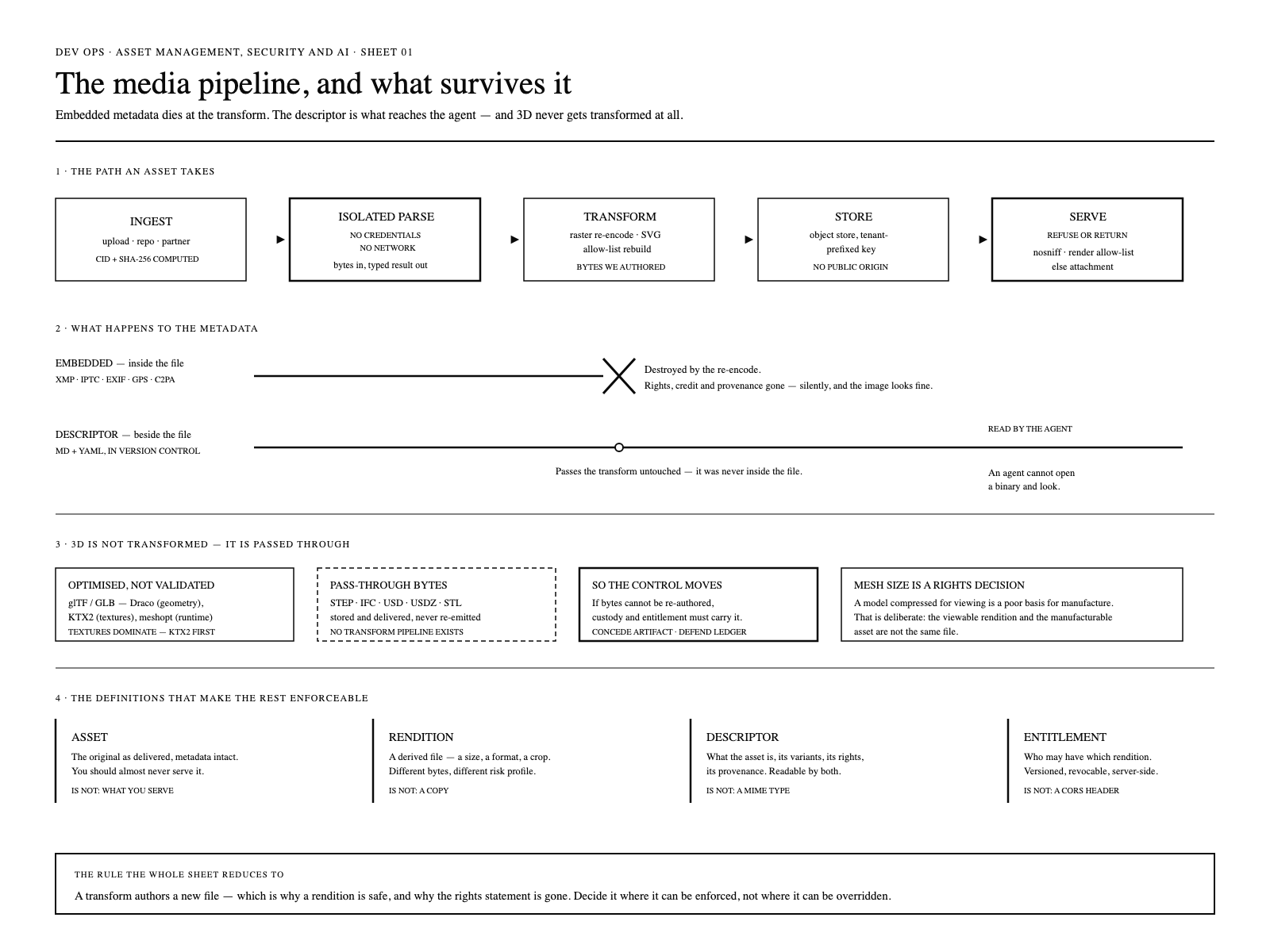
A transform is not an edit. When a pipeline resizes an image it does not modify the original — it authors a new file. That single fact decides both halves of this document: it is why a transformed asset is safe, and it is why your metadata is gone.
Most media problems in a commerce estate come from treating those two consequences separately. The performance team owns compression. The brand team owns metadata. The security team owns uploads. They are the same pipeline, and each decision one team makes silently settles a question for the other two.
The vocabulary, fixed here
Five words that get used interchangeably and should not be.
| Term | Means | Is not |
|---|---|---|
| Asset | The original file as delivered by whoever made it, with its metadata intact. | What you serve. You should almost never serve the original. |
| Rendition | A derived file produced by a transform — a size, a format, a crop. | A copy. It has different bytes, different metadata and a different risk profile. |
| Metadata | Fields carried inside the file: EXIF, IPTC, XMP. Capture data, rights, captions. | The DAM's database record. One travels with the file; the other does not. |
| Descriptor | A separate, readable record of what the asset is — variants, rights, usage, provenance. | A MIME type. MIME says how to decode bytes, not what they depict or who may have them. |
| MIME type | The transport-level declaration of format, e.g. image/avif, model/gltf-binary. | A guarantee. It is declared by whoever uploaded, and most parsers ignore it anyway. |
The distinction that does the most work later is asset versus rendition. A DAM that stores only renditions has thrown away the thing it exists to hold. A CDN that serves originals has skipped the step that protects it.
What a transform destroys, and why that is mostly good
Re-encoding an image discards everything that is not pixels unless the pipeline is explicitly told otherwise. That is not a bug — it is the mechanism.
| Carried in the original | Survives a default re-encode | Why it matters to you |
|---|---|---|
| Pixel data | Yes, lossily | The only thing most pipelines are configured to preserve. |
| EXIF — camera, lens, GPS coordinates | No | Stripping is a privacy win you get for free. A product shot from a studio carries that studio's address. |
| IPTC / XMP — creator, credit, rights, caption | No | A licensing exposure. The rights statement you paid for is deleted by the resize. |
| ICC colour profile | Usually, if configured | Drop it and brand colour shifts. This is the one people notice. |
| Embedded hostile payload | No | The reason a re-encode is a security control: the output is bytes your pipeline authored. |
| C2PA content credentials | No | Provenance signatures do not survive an unaware transform, which increasingly matters for AI-generated and AI-edited assets. |
So the rule is not "preserve metadata" or "strip metadata." It is: strip everything on the rendition, keep everything on the asset, and carry rights and provenance in a descriptor that does not depend on surviving a codec. A field that only exists inside the file will eventually be deleted by a resize nobody told you about.
Compression: two different problems wearing one word
Raster
Format choice beats quality tuning, and both beat arguing about it. AVIF is the smallest at equivalent quality and the slowest to encode; WebP is the safe default with effectively universal support; JPEG remains the fallback. The practical answer is to let the delivery layer negotiate per request rather than picking one and storing it — which is the case for edge transformation made in the next section.
Two failure modes are worth naming because they look like nothing from the outside. Serving a 2400px image into a 400px slot costs the user the full download and shows no visible defect, so nobody reports it. And re-compressing an already-lossy file compounds artefacts each pass — a rendition generated from a rendition, which is what happens when a DAM stores derivatives and transforms those.
Mesh
3D is where media managers are newest and the defaults are worst. A glTF file is a container: geometry, plus textures, plus material definitions.
| Lever | What it compresses | Typical effect | What it costs |
|---|---|---|---|
Draco (KHR_draco_mesh_compression) | Geometry only — positions, normals, UVs | Large reduction on vertex-heavy meshes | Lossy by quantization; requires a decoder on the client; decode time on load |
meshoptimizer (EXT_meshopt_compression) | Geometry, optimised for runtime | Smaller wins than Draco on size | Much faster decode — usually the better trade for interactive viewers |
| KTX2 / Basis Universal | Textures, as GPU-ready supercompressed data | Often the largest single win available | Transcode step; different quality characteristics from JPEG/PNG |
| Polygon reduction | Geometry, before any encoding | Unbounded | Irreversible; a craft decision, not a pipeline setting |
The counterintuitive part, and the one that saves the most bytes: textures usually dominate. A team that enables Draco and stops has compressed the smaller half of the file. If you do one thing to a 3D catalogue, convert the textures to KTX2. If you do two, add meshopt before Draco unless your viewer is load-time-bound rather than interaction-bound.
Mesh compression is also where mesh size stops being a delivery question and becomes a rights question. A model compressed for web viewing is a poor basis for manufacture, which is deliberate: the viewable rendition and the manufacturable asset should not be the same file. That is a permissions decision expressed as a compression setting, and it is the cleanest example in this document of the two teams settling each other's questions.
Programmatic resize: four rungs, in order of what they ask of the browser
| Approach | Mechanism | Works without JavaScript | Use when |
|---|---|---|---|
Native <img> with srcset/sizes/loading="lazy" | The browser picks and defers | Yes | Always, for content images. This is the baseline everything else should degrade to. |
UIkit uk-img | JS component bringing srcset, sizes and lazy loading to background images via data-src | No | A background image genuinely is decoration — CSS backgrounds have no native lazy or responsive mechanism, and this supplies one. uk-img="loading: eager" opts a hero out. |
| Platform-generated variants (Webflow, Shopify) | The platform writes srcset for you at upload | Yes | You accept the platform's breakpoints and formats in exchange for never thinking about it. |
| Edge transformation | Resize, crop and format negotiation at the CDN, from one stored original | Yes | You want one asset, many renditions, and a parse your origin never performs. |
The uk-img row carries the progressive-enhancement caveat that decides where it belongs. Because it is a JavaScript component writing a CSS background, the image does not appear at all if the script does not run — and a CSS background is invisible to assistive technology and to crawlers regardless. That is acceptable for a decorative band and wrong for a product shot. The rule that follows is simple: content is an <img> with an alt; decoration may be a background. If you cannot say which one an asset is, it is content.
Webflow and Shopify: opinionated in different directions
Webflow gives a media manager three controls and generates the rest. Responsive variants and srcset are produced at upload. Loading mode is set per image — lazy by default, eager for anything above the fold, which is the one setting that is routinely wrong on hero images. Interaction state is a separate layer, and the trap there is loading-state work that assumes an image has already arrived.
Both platforms are heavy-handed with media, and that is what makes them safe to use. Webflow decides your breakpoints and formats at upload and hands back markup you did not write. Shopify bans formats outright — most visibly SVG — and routes everything through its own CDN and URL grammar. Read as restrictions, those look like limitations. Read as policy, they are the bargain the Shopify Functions section already described, applied to media instead of code: you cannot misconfigure what you are not permitted to configure.
Look back at the failures in the previous sections. Every one is a decision somebody made wrongly — a Content-Type echoed back from an upload, a parser left on its shipped defaults, a file served inline from an origin that also serves checkout. Webflow and Shopify remove most of those decisions from the person least equipped to make them. A merchant with no security team gets competent srcset, a re-encoded raster whose bytes the platform authored, and no SVG executing on their own origin — without knowing any of those words. That is a genuinely good outcome and it deserves to be said plainly rather than treated as an obstacle to route around.
So the honest summary is: heavy-handed, secure, and usable without risk by people who should not have to think about any of this. For most teams that is the correct trade, and a platform generating competent markup automatically beats a bespoke pipeline nobody maintains.
The cost is narrow and specific. The decision is made at upload, and it is not revisable per surface later — you take their breakpoints, their formats and their grammar wherever that asset subsequently appears. That only becomes a problem at a scale and a variety most estates never reach. This document is written for the estate that has reached it, not for the one still served well by the defaults.
Where you have outgrown it, the recovery is not migration — it is Cloudflare Rules in front. Response header transforms set caching and content-type discipline on media paths you do not own; origin rules move a path prefix to storage you do control without touching the storefront. It is the only place policy can exist when the origin belongs to someone else.
Where the media actually lives: four models
| Model | Transform | Storage economics | Metadata handling | Where it breaks |
|---|---|---|---|---|
| Cloudinary (transform-first SaaS) | Its product. Deep, URL-addressable, excellent | Priced on transformations and delivery — costs scale with traffic | Strong for raster; configurable stripping | 3D and CAD are pass-through bytes, and the pricing model punishes exactly the high-traffic success you wanted |
| OpenText (enterprise DAM/CMS) | Present, governance-led rather than delivery-led | Enterprise licensing | Strongest of the four — rights, workflow, retention | Delivery performance and developer ergonomics; media reaches the web through something else anyway |
Filesystem / Next.js public/ | next/image at request time, or none | Cheap until it is not | None. The filesystem has no opinion | No governance, no rights record, no audit. Optimisation on the app server puts a parser in the request path, and the host's image optimisation is metered |
| R2-backed DAM (object store + Worker) | At the edge, or on an isolated worker | Storage and operations priced; egress is not | Whatever you build — which is the honest cost | You are assembling it. Nothing here is free the way a SaaS feature is free |
The egress line is the one that changes decisions at scale. Media is the largest thing most estates ship, and in the conventional model the bill grows with exactly the traffic the business is trying to win. Object storage without egress fees removes the term from the equation, which means a campaign that goes unexpectedly well does not produce an unexpected invoice. That is a structural difference, not a discount, and it is the single strongest argument for an R2-backed DAM over a delivery-priced one.
State the counterweight, because it is real: Cloudinary's transformation pipeline is better than what you will build in a quarter, and OpenText's rights and retention model is better than what you will build in a year. The R2 position wins on economics and on control of the serve path. It loses on everything that arrives finished in a product you can buy. Choose accordingly, and notice that the two can be combined — governed originals in one system, delivery from another.
ImageMagick, and what a media manager should require
ImageMagick is the software that almost certainly resizes your images. It is a thirty-year-old open-source toolkit — a command-line program and a set of language bindings — that reads, converts and transforms well over a hundred image formats. Almost nobody chooses it. It arrives underneath a CMS, a plugin or a base container image, and it does the work every time someone uploads a photograph and the system produces a thumbnail.
It matters to a media manager for one reason: validating a file means parsing it, and the parser is the attack surface. ImageMagick's own design compounds this. It determines format from file content rather than extension, so checking that a file ends in .jpg proves nothing. It hands PDF, EPS and PostScript to Ghostscript, chaining a second interpreter behind an innocent "generate a preview" feature. And its delegate system historically passed filenames into shell commands, which is how a hostile upload became remote code execution in the vulnerability known as ImageTragick.
| Platform | How it gets there | The one thing to require |
|---|---|---|
| WordPress | Uses the Imagick extension whenever it is installed | Force the GD editor if the site only resizes photographs; stop generating PDF thumbnails |
| Drupal | Core defaults to GD; ImageMagick arrives via contrib toolkit | Confirm which toolkit is actually selected before assuming |
| Magento | Selectable image adapter, inside PCI scope, serving pub/media from the checkout origin | Move media ingest and delivery off the commerce origin — scope reduction beats hardening |
| AEM | The DAM Update Asset workflow can shell out for EPS, PS and some PSD paths | Audit which renditions require it; Adobe's own Cloud Service direction moved processing off the author runtime |
The full hardening detail — policy.xml, the Ghostscript decision, the edge and origin controls — is in Dark Factory Entitlement Security, which also explains why we don't use Flash: the format was not killed by a better codec, it was killed by the realisation that content should not carry capability. Every argument in this section is that one applied to a file your brand team uploaded.
What a media manager should take from it is narrow and non-technical. Ask where the parse happens. Ask what that process can reach when it succeeds. Ask whether uploaded bytes are ever served from the same origin as checkout. You do not need to read policy.xml to insist that the answer to the third question is no.
MIME is not a descriptor, and AI is what makes that expensive
A MIME type answers one question: how should these bytes be decoded. It does not say what the asset depicts, which variants exist, who may use it, where it came from, or whether a model was approved for manufacture. Humans fill that gap by looking. Agents cannot.
This is now the binding constraint rather than an abstraction. An AI agent assembling a product page, answering a question or placing an order needs to resolve an asset to its meaning and its rights, and model/gltf-binary tells it neither. The estate's answer is a readable descriptor alongside the asset — Markdown with YAML front matter, the same shape the knowledge base already uses — carrying what the asset is, its variants and their intended surfaces, its rights and provenance, and the entitlement required to obtain the unwatermarked or manufacturable form.
This is not a new idea — photography got here first
XMP is not an Adobe format. Adobe created it in 2001, published the specification, and it was standardised as ISO 16684-1; the reference toolkit ships under a BSD licence. IPTC Photo Metadata — the news and stock industry's standard — is expressed in XMP. PDF/A requires it for document metadata. darktable, RawTherapee, digiKam and Capture One all write it, and C2PA uses it to reference a provenance manifest.
Open Adobe Bridge's File Info dialog and the tabs are a catalogue of what a single image can carry: Description, IPTC Core, IPTC Extension, Camera Data, GPS, Video Data, Audio Data, Categories, Origin, DICOM, History, Advanced — and Raw Data, which displays the XMP packet itself. Rights statements, contributor contacts, capture coordinates, an editing history, and in the DICOM case patient and study identifiers. All of it real, all of it structured, and all of it discarded by a default re-encode, as the table at the top of this document says.
Which is why photographers solved this twenty years ago, and solved it the same way. Camera RAW formats — CR3, NEF, ARW, RAF — are proprietary and largely undocumented, so writing metadata into them risks corrupting a file whose structure the vendor can change in the next firmware. The industry's answer was the XMP sidecar: IMG_1234.xmp beside IMG_1234.NEF. The RAW stays byte-identical forever; the ratings, edits, rights and captions live next to it. Adobe's own DNG is the exception that proves it — an open raw format, and therefore one XMP can safely be embedded in.
The descriptor argued for here is that pattern, reached from a different constraint. Photography put metadata beside the asset because the container was not safely writable. We put it beside the asset because the container will be re-encoded and because an agent needs to read rights without opening a binary. Same shape, same reason it holds.
And the same weakness, which is worth naming before someone else does: sidecars get separated. Copy the RAW without the .xmp and the rights statement is gone, silently, with the asset looking perfectly intact. That is the failure mode this model inherits, and it is the argument for keeping descriptors in version control — where the pairing is enforced by a commit rather than by whoever dragged the folder — and for a system of record that holds the same fields independently.
One company wrote most of this stack, and that is why the parsers are dangerous
Follow the formats back and they converge on one vendor. PDF is Adobe's, from 1993, now ISO 32000. PostScript and EPS are Adobe's. XMP is Adobe's, now ISO 16684-1. PSD and AI remain proprietary. DNG is Adobe's open raw format. The pattern is consistent: publish the specification, let it become universal, keep the tooling.
That is worth noticing twice over.
First, it is the strongest position in this document. Adobe did not win by having the best codec. It won by making its formats the ones everything else must read, then selling the tools. A standard is a better moat than an invention, because nobody needs permission to adopt it and everybody needs your software to author it well.
Second, and less comfortably: the formats with the worst parser histories are the same ones. The delegate chain that turns a thumbnail request into a second interpreter — PDF, EPS and PostScript handed to Ghostscript — is Adobe formats end to end.
But Ghostscript is not Adobe's, and the distinction is the whole point. It was written by L. Peter Deutsch in 1986, developed by Aladdin Enterprises, and is maintained today by Artifex Software under a dual AGPL and commercial licence. It is an independent implementation of Adobe's languages, and it is the one that actually runs — on Linux servers, in container images, behind ImageMagick's PDF delegate, in most places a thumbnail gets generated.
So the burden splits. Adobe owns the specifications; a third party Adobe does not fund carries the security consequences of everyone adopting them. That is what winning a standard actually looks like from the outside: the format becomes universal, implementations get written by people with no relationship to its author, and the risk lands on whoever wrote the parser that shipped in the base image.
It is worse here than the general case, because PostScript is not a document format. It is a Turing-complete programming language, which is why Ghostscript needs a -dSAFER sandbox at all — and why that sandbox has had to be repaired more than once. A "generate a PDF preview" feature is an offer to execute a submitted program.
None of which is hypocrisy on anyone's part. It is arithmetic. Ubiquity is what makes a parser worth attacking, and a format every system must read is a format every attacker studies. The price of winning the standard is that your format becomes the one worth breaking, whoever ends up maintaining the code that reads it.
Where the pattern breaks, and what it explains
Three-dimensional content is the exception, and the exception is instructive.
Mesh compression is not Adobe. Draco is Google's. meshopt is independent. KTX2/Basis Universal came from Binomial, acquired by Google. glTF is Khronos. Adobe arrived in 3D by acquisition — Substance for materials, Mixamo for characters — into a field whose formats were already set by other people.
That timing explains something this document asserts earlier. 3D formats arrived after the era in which one vendor made a format universal and then had to build the tooling to match, and the standards came instead from a consortium and a search company with no document-pipeline business to extend. Nobody ever had Adobe's incentive to build a safe, ubiquitous transform pipeline for meshes — and so, as the section above says, models remain pass-through bytes while a JPEG is re-encoded by default.
The absence of a transform pipeline for 3D is not an oversight. It is the predictable result of nobody owning the format the way Adobe owned the page.
The system of record is the other half
A descriptor beside the file answers what is this. It does not answer which variants exist right now, and which may this surface serve. That is a query, and queries need a database.
Xano's Metadata API is the shape of that half: programmatic access to schema, content and a distinct Files scope for file storage, under the same RBAC that governs everything else — and the documentation is careful to note that effective permission is the narrower of the token's scope and the role's, which is the correct default for anything touching assets.
Pairing them is what makes optimisation dynamic rather than baked. The descriptor travels with the asset and states its rights and provenance. The system of record holds the variant set, the surface bindings and the entitlement, and it can be queried at request time — so a page asks for the variant appropriate to this surface and this viewer instead of receiving whatever format was decided at upload. That is precisely the limitation the Webflow and Shopify section names: their decision is made at upload and is not revisable per surface. A descriptor plus a queryable record is how you get it back, without leaving either platform.
Three properties make that work where an embedded field does not. It survives the transform, because it was never inside the file. It is diffable, so a rights change is a reviewable commit rather than a silent metadata write. And it is readable by both, which means the agent and the media manager are looking at the same record — not a database view and a file header that disagree.
MIME still does its job at the transport layer, and the serve path should still hold a strict allow-list of what may render inline. That is a safety control. The descriptor is a meaning control. Conflating them is why so many DAMs can tell you a file is a PNG and not tell you whether you are allowed to publish it.
The parser your AI pipeline did not know it had
Everything above concerns assets you publish. This section concerns assets you ingest, and it is where the two halves of this document meet — because a retrieval system is a media pipeline that happens to produce answers instead of pictures.
PDFs are the dominant enterprise document format, so any system indexing internal documents is parsing them. The common routes — document loaders, OCR pipelines that rasterise a PDF before reading it, a thumbnail step using ImageMagick's PDF delegate — end at a PostScript interpreter for at least some inputs. Most teams do not know it is in the path. It arrived with a base image.
The privilege is inverted
This is the part that matters, and it is almost universal.
Enormous care goes into sandboxing the model: restricted tools, filtered outputs, guardrails, evaluation. Meanwhile the ingestion worker — the component that actually receives attacker-supplied documents — runs as an ordinary process holding the embedding API key, the vector store credentials, database access and a route into the private network.
The component receiving hostile input has more privilege than the component everyone is protecting.
What that exposes
| Exposure | Why it matters here |
|---|---|
| Credentials and corpus | Compromise the ingestion worker and you hold the embedding key, the vector store, and every document already indexed. A retrieval corpus is a deliberately concentrated collection of an organisation's internal documents — a better target than model weights |
| SSRF from inside the perimeter | These parsers fetch URLs. An ingestion worker sits within reach of internal APIs and the cloud instance-metadata endpoint, which vends credentials. A document that triggers an outbound request from in there is a pivot |
| File disclosure into the index | Constructs like label:@/path read a local file into the rendered output. If that output is then OCR'd and embedded, a server-side file becomes an ordinary chunk in the vector store — retrievable later by asking the assistant a plausible question |
| Ingestion denial of service | Decompression and rendering bombs stall the pipeline. Needs no vulnerability; a timeout is the only thing that stops it |
The third row deserves reading twice. The exfiltration channel is the assistant's own answer. No outbound connection is required at any point, so egress monitoring sees nothing and a network policy prevents nothing. The data leaves by being retrieved.
This is not prompt injection, and the difference is the point
Two attacks arrive in the same uploaded document. Only one of them gets discussed.
Prompt injection is content manipulating the model. It makes the assistant misbehave, it is what the industry threat-models, and there is a growing literature on it.
Parser compromise is content executing on the host, and it runs before the model is ever invoked. It does not make the assistant misbehave — it makes your infrastructure misbehave. It is strictly the worse of the two, and it receives a fraction of the attention, because the parser is not the part anybody thinks of as AI.
The same bargain, one layer earlier
The fix is the one this document keeps arriving at: parse where a compromise costs nothing.
- Run ingestion in an isolated sandbox with no credentials and no network. No embedding key, no database, no route inward. Hand it bytes; take back text.
- Prefer pure-library extraction over shelling out to a rasteriser — fewer processes, and no delegate system to configure wrongly.
- Harden
policy.xml, and remove Ghostscript where nothing genuinely needs PostScript rendering. - Treat the ingestion worker as untrusted infrastructure, because that is exactly what it is.
And it connects back to the descriptor argument. An agent that can read an asset's rights from a descriptor beside it does not need to open the binary to find out what it may do. Every parse avoided is an attack surface that was never presented — which is the whole of this document, stated once more at the point where assets stop being published and start being consumed.
Best practice: the container is the control
The isolation this document keeps prescribing needs a shape, because "sandbox it" is advice nobody can act on. What follows is the envelope, then what changes per artifact class, then where the platform layers sit.
The envelope
One parse, one container, and the container holds nothing worth taking.
| Property | Setting | Why |
|---|---|---|
| Credentials | none injected — no API key, no database URL, no cloud role | The parse cannot leak what it was never given |
| Egress | denied by default | Kills SSRF, external entity fetches and exfiltration in one rule |
| Filesystem | read-only, with one tmpfs scratch | Nothing written survives, and nothing on disk is worth reading |
| Identity | non-root, all capabilities dropped | A container escape has nowhere to escalate to |
| Limits | hard CPU, memory and wall-clock caps | Decompression and rendering bombs need no vulnerability |
| Lifetime | one-shot, never reused across tenants | No residue between jobs |
| Interface | bytes in, typed result out, size-capped | The Functions bargain, in a container |
A worker isolate reaches the same contract by a different route — no filesystem, no ambient network, bindings granted explicitly — which is why the same discipline can run at the edge for small inputs and in a container for large ones.
Per artifact class
| Class | What opens it | Where it goes wrong | Practice |
|---|---|---|---|
| Ghostscript for raster; poppler or a library for text | PostScript is a language, so rendering is executing. The delegate chain is reached by content sniffing, not extension | Extract text with a library and never shell out. Rasterise only inside the envelope. Disable the PDF, EPS, PS and XPS delegates. Uninstall Ghostscript where nothing needs PostScript | |
| SVG | An XML parser, then a renderer | It is XML — external entities. Inlining promotes it from the image sandbox to a DOM node | Never inline untrusted SVG. Rebuild from an allow-list, or serve as <img> so the browser sandboxes it. Keep it off the inline-render list on the serve path |
| 3D — glTF / GLB | JSON plus binary buffers, then a decoder | External URIs in buffers and images pull remote content at load. Draco and KTX2 decoders are native code on untrusted input | Reject any external URI reference at ingest — self-contained or refused. Decode inside the envelope |
| 3D — STEP / IFC / USD | CAD kernels, and ifcXML for the XML flavour | No transform pipeline exists, so these are pass-through bytes. ifcXML is XML, with the same entity problem. Models are large enough that memory limits matter | Store and serve without parsing. If you must parse, the envelope is not optional. Entitlement carries what the bytes cannot |
| Firmware | Nothing should open it | The risk is distribution and installation, not parsing — and it is the worst case in this table. See below | Content-address it, sign the payload, and verify on the device. Full treatment in the next section |
Firmware is the one that deserves its own rules
Everything else in that table fails inside a process you control. Firmware does not, and the difference is worth stating in full because it is routinely handled like a download.
Why it is categorically worse. A compromised image executes on a device, outside every control you own — no container, no allow-list, no endpoint agent, no browser sandbox. It runs at or beneath the operating system, so it can persist through a reinstall of everything above it. Many devices have no rollback path, so a bad flash is not an incident you remediate, it is hardware you replace. And the population is not one machine: a poisoned image reaches every device that asks for an update.
TLS is not provenance. A download over HTTPS proves you reached a server with a valid certificate. It does not prove the bytes are the ones the vendor built. Anyone who can write to that origin — a compromised build agent, a mis-scoped storage bucket, a stolen deploy token, a CDN misconfiguration — serves signed-looking firmware over a green padlock. A raw firmware download whose only integrity claim is the transport is an exposure waiting for someone to notice it.
The bundle is the attack surface, not the image
Firmware rarely ships as a bare image. It ships as an archive: a manifest, one or more payloads, and an installer. That shape adds a whole attack class before the image is ever written to a device.
| Risk | What it looks like | Control |
|---|---|---|
| Path traversal on extract | Entry names containing ../, absolute paths, or symlinks that escape the extraction root and overwrite a system file | Extract to a quarantine directory. Reject any entry that resolves outside it, and refuse symlinks and hard links outright |
| Archive bombs | A small archive expanding to fill the disk, or millions of entries | Cap entry count, per-entry and total uncompressed size, and compression ratio, before writing anything |
| Signature scope confusion | The archive is signed but individual files are validated, or files are signed but the manifest is not — so an entry can be substituted after the check | The signature must cover a manifest that itself carries a digest for every file. Verify the manifest signature first, then every payload against its digest |
| Time-of-check to time-of-use | Verified in one directory, installed from another, with a window in between | Verify and install from the same immutable bytes. Never re-read a file between the check and the flash |
| The manifest is a program | An XML or JSON manifest tells the installer which files go where and what to execute — with the installer running at high privilege | Parse it with DTD processing and external entities disabled, validate it against a schema, and treat every path in it as untrusted input |
That last row is where this connects to the section below. A firmware manifest is XML that directs privileged file placement and execution. External entity resolution turns it into a file read; an unvalidated path turns it into an arbitrary file write; and the installer supplies the execution. Three ordinary defaults, composed, are a device takeover.
What actually protects a firmware channel
- Sign the payload, not the transport. A detached signature over a manifest that digests every file, with the public key held by the device.
- Verify on the device, immediately before flashing — not on the server that served it, and not by the installer that will also perform the write.
- Content-address the bundle and publish the digest somewhere you do not control. If the address lives only on the same host as the download, an attacker who owns the host owns both. An independent copy means a device — or a customer — can check what the vendor actually published against what they received.
- Anti-downgrade. A monotonic version counter enforced by the device, so a correctly signed older image with a known flaw cannot be replayed as an update.
- Gate the download on entitlement, so the serve path refuses rather than merely obscures. An unlisted URL is not access control.
- Keep a bill of materials for the image and be able to answer, later, what was in a build that shipped two years ago. Regulators increasingly require this; incident response has always required it.
The test, stated plainly: if someone replaced the bytes at your download URL tonight, what would stop a device from installing them? If the answer is "the certificate," the channel is unprotected. If the answer is "the device would refuse the signature, and the published digest would not match," it is a channel.
MIME types a DAM has to hold — and there are four of them per file
The commonest bug in asset handling is treating "the MIME type" as one value. It is four, they disagree, and every disagreement is where something goes wrong.
| Which type | Where it comes from | Trust it? |
|---|---|---|
| Declared | The uploader's Content-Type or the file extension | No. Attacker-supplied, and most parsers ignore it anyway |
| Detected | Magic bytes, read in your own code | Mostly. This is what a parser will actually act on |
| Stored | What the DAM records against the object | Only if you set it from detected, never from declared |
| Served | The Content-Type on the response, plus the inline-or-attachment decision | This one is a decision, not a property |
A DAM must record all four and reconcile them. Declared ≠ detected is itself a signal worth logging — it is occasionally a misconfigured client and occasionally someone testing you.
The protection funnels, and what each one does not do
"Sanitised" means different things per family, and the differences are not details.
| Family | The funnel | What comes out | What it does not fix |
|---|---|---|---|
| PNG · JPEG · WebP · AVIF · GIF | Re-encode — decode and emit fresh | Bytes your pipeline authored. Any embedded payload is gone because it was never re-emitted | Metadata is destroyed with it — rights, credit, C2PA. And the decode still happened on your infrastructure |
| SVG | Allow-list rebuild — parse, walk, reconstruct | A document containing only what you permitted | Not a re-encode. You are trusting your allow-list rather than a codec. A construct you did not anticipate is dropped, which is the right default but not a proof |
| Video | Transcode | New bytes, same as raster | Expensive, and the demuxer surface on ingest is larger than an image decoder's |
| None that sanitises | — | Extract text with a library, or render in the envelope. There is no "clean PDF" step | |
| Fonts — WOFF2 · TTF | None practical | — | Parsed by the browser's text engine, historically a rich target. Serve from a separate origin; do not accept them from uploaders |
| 3D — STEP · IFC · USD · USDZ | None exists | — | Pass-through bytes. Custody and entitlement carry what the format cannot |
| Archives — ZIP · USDZ · STEP+ZIP | None | — | Container rules: traversal, symlinks, entry caps, ratio caps |
Office documents, and the direction nobody checks
Word, Excel and PDF deserve their own row set, because SaaS platforms both accept them and generate them — and the second direction is the one that goes unexamined.
What they actually are matters more than their icons suggest:
| Format | What it is underneath | Inherits |
|---|---|---|
| DOCX | A ZIP archive of XML | Every archive rule — traversal, entry caps, ratio caps — and every XML rule: DTDs and external entities off |
| XLSX | A ZIP archive of XML, plus a formula engine | The same two, plus formulas, external workbook links and legacy DDE |
| A document format descended from a programming language | The Ghostscript delegate chain, embedded JavaScript, and attachments |
The first column surprises people: a Word document is a zip file. Everything the firmware section says about archives applies to a résumé upload, and everything the XML section says about entities applies to the document.xml inside it.
Now the direction nobody checks. A platform that generates a document feels safe, because the bytes are ones it authored. That reasoning holds for a re-encoded JPEG and fails here:
An export carries your users' input to your customer's desktop. If a field containing
=cmd|…or=HYPERLINK(…)is written into a CSV or XLSX export, the spreadsheet that opens it may evaluate it — on a machine you do not control, belonging to someone who trusts the file because it came from you.
That is formula injection, and it is a serving vulnerability rather than an ingestion one. The platform is not compromised; its customer is, using a document the platform produced correctly. Neutralising it is a one-line discipline at export: prefix any cell beginning =, +, - or @ so it is written as text.
| Direction | What to do |
|---|---|
| Accepting DOCX or XLSX | Treat as an archive first: extract in the envelope, refuse traversal and symlinks, cap entries and ratio. Then treat the contents as XML with entities disabled |
| Accepting PDF | Extract text with a library. Rasterise only inside the envelope. Do not invoke a preview chain on the request path |
| Generating CSV or XLSX | Neutralise leading formula characters in every user-derived field |
| Generating any of them | Set Content-Disposition: attachment and nosniff. A generated document is still a document, and browsers render some of them |
The sentence the table is really making: re-encoding protects the consumer, not you. It converts "a hostile file reaches every viewer" into "a hostile file reaches my decoder" — which is a large improvement and not an escape. The decode happens on your infrastructure either way, which is why the envelope above is the control and the funnel is the benefit.
Enforcing the four types at the edge
The four types above are a modelling distinction. Two of them can be enforced in configuration, on origins you do not control — which is where most estates need it.
Inbound — refuse on the detected type, not the declared one. A WAF custom rule can match http.request.body.mime, the type Cloudflare detects from the bytes of a multipart upload:
(http.request.uri.path contains "/upload"
 and not http.request.body.mime in {"image/jpeg" "image/png" "image/webp" "application/pdf"})
Allow-list, so a format invented after the rule was written is refused rather than admitted by omission. The disagreement itself is worth a rule of its own, because declared ≠ detected is the signal, not the nuisance:
(http.request.headers["content-type"][0] contains "image/"
 and not http.request.body.mime in {"image/jpeg" "image/png" "image/webp"})
Outbound — decide the handling, since you cannot inspect the body. A response header transform rule on a media prefix sets what the browser is permitted to do with whatever arrives: X-Content-Type-Options: nosniff, Content-Disposition: attachment, and on paths that must never render inline, Content-Type: application/octet-stream. That is the served type from the table above, imposed on an origin that never asked your opinion.
Three limits, stated before anyone leans on this. Body inspection is plan-gated and bounded — it sees the bodies Cloudflare parses, up to a size, so a large or streamed upload may pass uninspected and the rule is not a guarantee. Matching is not sanitising: a file whose detected type is genuinely image/png can still be a hostile PNG, and nothing here touches the parser. And it remains a layer rather than the boundary — edge rules constrain what a served response may do; the serve path decides whether it is served at all.
Where this earns its place is precisely where code cannot go: a hosted storefront, a CMS you do not run, a vendor's app. There it is the only place the policy can exist.
Permissions gating on shapes that are not yours
Two identifier classes turn up in asset metadata and they behave in opposite ways. Confusing them is how a gate ends up keyed on something that moves.
| Vendor identifiers | ISO codes | |
|---|---|---|
| Examples | Webflow item id, Shopify GID, storage key | ko (639-1), KR (3166-1), KRW (4217), 8601 timestamps |
| Scope of meaning | One system | Every system |
| Stability | Stable, opaque, meaningless elsewhere | Standardised, shared, externally defined |
| Safe as a gate key? | Yes, within its system | Yes, across systems |
| Safe as a display value? | No | No — render the name, store the code |
ISO codes are the only identifiers in the estate that nobody owns, which is what makes them the one dimension a permission can be scoped on across systems without a mapping table. A rule reading this subject may receive assets for KR in ko means the same thing in the DAM, the worker, the warehouse and the feed. Nothing else in the metadata has that property.
Three gating strategies follow, in increasing order of what they protect:
- Scope the entitlement on the ISO pair, not on a market name.
market=KRsurvives a rename, a translation and a re-org. "Korea Store" survives none of them, and a gate keyed on it fails open the day someone edits a label. - Validate the code at the boundary, on write. A country that is not in ISO 3166 is refused at ingest rather than discovered in a rejected feed. An entitlement scoped to a code that does not exist matches nothing and refuses silently — which looks exactly like a permissions bug and is really a data bug.
- Never let a display name reach a comparison. Display names are translated, and a translated key fragments the very dimension it exists to unify —
KR, "Korea" and "한국" become three scopes where there is one market.
And the class distinction is the point. A vendor identifier gates within a system; an ISO code gates across them. Asset permissions usually need both — the storage key says which object, the ISO pair says which market and language it may serve — and mixing them up produces a rule that is correct in one system and meaningless in the next.
What no funnel covers
Worth listing, because these are the things people assume a sanitiser handled:
- Rights and provenance. Destroyed by the very step that made the file safe. This is the descriptor's job, and the reason it exists.
- The filename. Attacker-supplied, and it reaches a filesystem. Normalise it; never trust it.
- Whether the person may have it. A sanitised asset served to the wrong subject is a clean file and a breach.
- What the asset depicts. No pipeline knows whether an image is a product shot or a customer's passport. That is a classification problem and it stays with people and policy.
Where XML throughput meets the Ghostscript problem
They are the same bug wearing different clothes, and it is worth naming because the control is one line rather than an architecture.
Ghostscript's danger is that a PostScript document instructs the interpreter. XML's equivalent is the external entity: a document that instructs the parser to fetch a local file or a URL and inline the result. Both turn "read this file" into "do what this file says."
That matters here because XML is underneath more of this estate than it looks. SVG is XML. XMP — the metadata this document spends a section on — is RDF/XML, and it rides inside PDFs, JPEGs and TIFFs. ifcXML is XML. So an XMP read on an uploaded image is an XML parse, and an XML parse with default settings resolves entities.
Disable DTD processing and external entity resolution in every XML parser you configure. One setting, and it covers SVG, XMP and ifcXML together. It is the -dSAFER of the XML world, with the same caveat: it is a policy inside the parser, not a boundary around it, so the envelope still does the real work.
Where the platform layers sit
The system of record holds entitlement and the descriptor — who may have which rendition, and what the artifact is. It is never in the parse path. A record that parsed the file it describes would be a parser with a database attached, which is the arrangement the whole section exists to prevent.
Edge rules carry the serve-path discipline that needs no code: response headers forcing nosniff and Content-Disposition on media paths, origin routing that moves an upload prefix off the application origin, rate limiting on the ingest endpoint so a parse cannot be minted on demand, and managed rules as a detection layer — not a boundary, since format is decided by content.
Neither replaces the envelope. Rules constrain what a served response may do; the container constrains what opening the file may do. Different questions, and only the second one is about the parser.
Moving the compile to AI is not a permissions change
There is a move being made across a lot of estates right now: take the step that used to parse, extract, transform or classify an asset, and hand it to a model instead. It is usually framed as modernisation, and often it is. It is not a security control, and it is being treated as one.
Four things stay exactly where they were.
The parser did not go away. Something still decoded those bytes before the model saw anything — a PDF was rasterised, an image was demuxed, a document was extracted. Handing the result to a model changes who consumes the output. It does not remove the process that opened the file, and that process is the one this document has been about.
The model's runtime holds the privilege. Inference needs an API key, usually network access, often the document store and the vector index. The model has no permissions of its own; it inherits whatever the process around it was given. An LLM reading a contract is a process with credentials reading a contract.
The output is now untrusted too. Model output is generated from attacker-reachable input, so anything downstream that acts on it — a query, a file write, a tool call, a rendered page — is consuming content an outsider influenced. The transformation added a second untrusted surface rather than removing the first.
And nothing was permitted or refused. No subject was identified, no permission was checked, no refusal was possible. A processing step changed. That is all that happened.
What is actually required
The permissions boundary stays where it was, and it stays the same shape: one place, on the server, that every path calls, which can refuse. The model sits inside that boundary as another thing a subject may be permitted to invoke — never as a substitute for it, and never as the thing deciding.
The discipline to copy is the one this document already named twice: typed in, typed out, no ambient authority. The Shopify Functions bargain works because the runtime denies by default and the host grants specific, declared inputs. Apply the same contract to an inference step and it becomes safe in the same way — it receives exactly what it was handed, returns a typed result, and reaches nothing else. Apply it to a model with a database connection and an outbound route and you have not applied it at all.
The half that a boundary cannot supply by itself is the record of who may do what, versioned and revocable. That is a system-of-record question, and in this estate it is Xano holding the entitlement and the permissions beside the asset metadata — one row per subject, checked by the same server-side call regardless of which surface or which model made the request.
Stated plainly, because it is now the requirement rather than a preference: an AI step is permitted work, not permitting work. It belongs behind a permissions boundary with a system-of-record answering for it, and moving a compile step to a model without that is a change of implementation dressed as a change of posture.
The stack, and which layer may refuse
CORS judged alone looks like a broken access control. Rules judged alone look like a partial security product. A system of record judged alone looks like it never touches the serve path. Each reads as a gap, and the reading is the mistake: these are not three partial solutions. They are four different questions, and each layer answers exactly one of them.
| Layer | Where it runs | May it refuse? | The question it answers |
|---|---|---|---|
| System of record (Xano) | server | yes | Who is entitled to this asset, and which variants exist |
| Worker (Cloudflare) | edge, server-side | yes — this is the boundary | Do we serve it, or refuse |
| Rules and response headers | edge | constrains, does not decide | How may it be handled once served — nosniff, disposition, caching, rate limiting |
| Content platform (Webflow) | a separate origin | no | Where content is authored, and from which origin its assets are served |
| CORS | the browser, on your instruction | narrows reads | Who may read this response cross-origin |
| Presentation (UIkit) | the browser | no | How it looks |
A request passes all four in order. Edge rules apply first — rate limit, managed ruleset, origin routing. The worker resolves the subject and asks the system of record whether that subject is entitled. The worker refuses or serves; this is the only place a decision is made. If it serves, it reads from object storage by tenant-prefixed key, normalises the filename, and sets the content type from a render allow-list with nosniff. Then the cross-origin headers decide who may read the result in a browser, with credentials on a strictly narrower allow-list than reflection.
Five refusals, five different reasons, nothing redundant. Defence in depth means layers answering different questions — layers answering the same question are duplicated code with two places to get it wrong.
Which is why the usual complaint dissolves. CORS "fails" as an access control because it was never asked to be one, and in this arrangement it is not asked to be: entitlement is answered before the response exists, so the cross-origin rules are free to do the narrow job they are actually good at. Paired, they resolve the access question completely.
Two layers that contribute something other than a decision
Webflow contributes origin isolation, which is real, and no authorisation, which is also real. Its assets come off its own CDN, so a script that manages to run there is not running on the origin that serves checkout — the entire reason an SVG is tolerable from a content platform and refused from your own upload path. Its re-encoding of rasters hardens images incidentally, as the section above describes. What it cannot do is decide anything: a content row may describe an asset; it must never determine who may have it. A CMS field is an input to the system, authored by whoever holds a seat, and inputs are not decisions.
The presentation layer contributes no security at all, and can spend what the others provided. It runs in the browser, which the attacker owns — devtools, edited DOM, requests replayed with no script involved. Nothing there can refuse anything.
The uk-svg case is the clean illustration and worth stating because it looks like a hardening feature. The server sends an SVG; the browser sandboxes it as an image, where script cannot run; a presentation component then fetches it and injects it inline with all its attributes, which promotes it to a node in your document where script does run. Stylability was bought with the sandbox. That trade is correct for a logo in your own repository and catastrophic for anything an uploader supplied — and the front end is the wrong place to make it, which is why the render allow-list lives on the serve path instead.
The rule that falls out: decide it where it can be enforced, not where it can be overridden. A client can only spend the safety a server provided. It can never create any.
Two things sit outside the stack entirely, and both have their own answers earlier in this document: the parser, which is contained by isolation rather than by permission, and provenance, which travels in a descriptor beside the asset. Those are not gaps in this arrangement. They are different problems, and conflating them is how estates end up with four mechanisms that all answer "who" and none that answer "what is this" or "what may it execute".
What CORS is, precisely
Worth stating exactly, because the assumption is near-universal: CORS is a browser-enforced restriction on reading responses, not an access control. It stops one site's JavaScript from reading another site's response using the visitor's ambient credentials. It does not stop the request — a non-browser client ignores it completely — and it does not protect data an endpoint would return anyway.
What protects an asset is the code that decides whether to serve it: no public bucket origin, so every read passes something that can refuse; tenancy in the object key rather than a parameter; filenames normalised so a crafted name cannot traverse; and an allow-list deciding what may render inline at all. The cross-origin rules narrow what a browser may then do with the response, which is a real and useful second layer and is not the boundary.
The practical consequence for the table above: the serve path is cheap to harden, because header discipline, origin routing and rate limiting are configuration. The expensive half is everything CORS was never going to answer — who is entitled to this asset, which variants exist, and who may change that.
AI Scoped Remediation
Ordered by how much introducing AI changes the exposure, not by generic severity — because that is the question an estate is actually asking. Everything here is drawn from the sections above; this is where it becomes a list someone can work through.
| Exposure | What AI changes about it | Remediation | Residual cost |
|---|---|---|---|
| Ingestion parser privilege | Transforms it. The worker receiving hostile documents holds the embedding key, the vector store and a route inward — more privilege than the model everyone is guarding | Parse in an isolated sandbox with no credentials and no network. Hand it bytes, take back text. Prefer library extraction over shelling to a rasteriser | An extra hop, and an ingestion path that is slower and harder to debug |
| File disclosure into the index | Creates it. A construct that reads a server file into rendered output becomes a retrievable chunk — the exfiltration channel is the assistant's own answer, so no egress control sees it | The isolation above removes the primitive. Additionally, never index the output of a rendering step that ran with filesystem access | Some OCR-dependent pipelines need rework |
| An AI step mistaken for a permission | Creates it. Moving a compile step to a model changes implementation, not posture — nothing was identified, checked or refused | Keep the permissions boundary server-side and unchanged; the model sits inside it as permitted work. Entitlement stays in the system of record | Discipline, permanently. The shortcut is always available |
| Model output treated as trusted | Creates it. Output is generated from attacker-reachable input, so anything acting on it consumes influenced content | Treat model output as untrusted input to the next stage — typed, validated, and never executed or interpolated unescaped | Extra validation at every seam |
| Rights invisible to an agent | Sharpens it. A human opens the file and looks; an agent cannot, and model/gltf-binary carries neither meaning nor rights | Descriptor beside the asset — rights, variants, provenance — in version control so the pairing survives a copy | Discipline. Nothing enforces a descriptor's existence but review |
| Provenance lost in transform | Sharpens it. C2PA credentials do not survive an unaware re-encode, and AI-generated content makes that lineage matter more each year | Carry provenance in the descriptor rather than only inside the file. Preserve C2PA where the pipeline is provenance-aware | Provenance is only as good as the weakest transform in the chain |
| Variant chosen at upload | Unchanged by AI, but it is what blocks per-surface serving | Query the system of record at request time instead of baking a decision at ingest | The one genuinely unbuilt item — see the build-cost note below |
| Edge transformation dependency | Unchanged | Accept it deliberately: a parser removed from your origin by depending on a vendor's | A trade, not a win. Say so out loud |
| Lossy mesh compression | Unchanged | Keep originals. The rendition is not the asset — and a model compressed for viewing is deliberately a poor basis for manufacture | Low if originals are kept, total if they are not |
The ordering is the argument. The first four rows did not exist as concerns before an estate put AI on its documents. The last three are ordinary media-pipeline trades that AI leaves exactly as it found them. Anyone remediating top-down is fixing the things their AI programme actually introduced, in the order it introduced them.
Why the build cost is not what it looks like
The objection to an assembled DAM is that you inherit ingest, entitlement, a rights surface and variant management. Stated flat, that is a large bill and a fair reason to buy instead.
It is also the wrong unit of account, because almost none of it is asset-specific.
An entitlement record does not know it is describing an image. A permissions boundary that refuses a request does not care whether the resource is a row, a route or a rendition. If an estate already operates those — and any estate doing commerce, consent or agent access already does — then adding assets is binding a new resource type to a boundary that exists, not standing one up. In this estate the same hasCap-style check guards media, documents, vault assets and API routes alike; the media path was not given its own authorisation model, which is precisely why it did not get its own authorisation bugs.
That reverses the usual build-versus-buy reasoning. A dedicated DAM gives you asset features quickly and brings its own permissions model, which then has to be reconciled with the one you already run — and reconciliation between two authorisation systems is where the real defects live, not in either system alone.
So the honest bill is short. Serve-path hardening is configuration. Entitlement, ingest and rights are reuse if you have them and genuinely expensive if you do not. Variant management is the one item nobody gets for free — though edge image transformation supplies the raster half, leaving the question of which variant a surface may serve, which is a query against the record you already keep.
What to do next
- Separate assets from renditions in storage. If one bucket holds both, nothing below this line is enforceable. Owner: DAM lead.
- Move media ingest and delivery off the commerce origin. Highest security value per hour spent, and the only item here with a PCI argument behind it. Owner: Platform.
- Audit loading modes on above-the-fold images. Lazy heroes are the most common measurable defect in a Webflow or Shopify estate. Owner: Front-end.
- Convert 3D textures to KTX2 before touching Draco. Larger win, less client cost. Owner: 3D/Media.
- Write descriptors for the top fifty assets by traffic. Enough to prove the shape before committing to a format. Owner: DAM lead with Content.
- Ask the three ImageMagick questions. Where does the parse happen, what can it reach, does it share an origin with checkout. Owner: Security with Platform.
Companion: Dark Factory Entitlement Security — why content should not carry capability, and the full parser-hardening detail. This document is the media manager's half of the same argument.